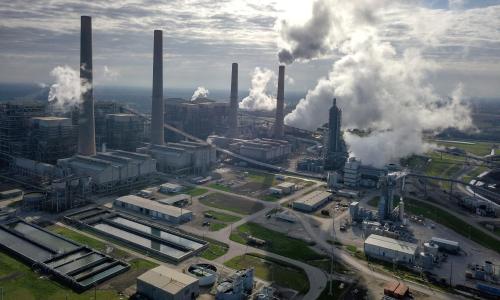
Carbon capture, utilization, and storage (CCUS) is a set of technologies intended to separate, collect and store carbon dioxide (CO2) emissions from industrial processes, with the goal of keeping them from entering the atmosphere and contributing to climate change.
However, CCUS comes with significant environmental, health, economic and social risks. And fossil fuel companies have repeatedly invoked CCUS to delay the necessary transition away from these polluting fuels. These kinds of risks will be amplified without comprehensive, fair, science-based regulatory policies and governance.
CCUS has limited uses and poses potential harms. Addressing the climate crisis continues to require, first and foremost, phasing out fossil fuels and transitioning our economy to safer and less-polluting options. Properly regulated CCUS could be a targeted part of a larger strategy to curtail heat-trapping emissions and limit climate change, but it’s not a substitute for urgent action to ramp up clean energy nor a legitimate reason to continue the fossil fuel status quo.
CCUS should only be targeted to address CO2 emissions from processes where fossil fuels cannot be directly phased out or where non-fossil CO₂ emissions are intrinsic to a production process, and where direct electrification or other more-efficient, less-polluting solutions are not available or practicable. For example, power generation has much better, cleaner options than burning fossil fuels in the first place. When CCUS is deployed, it must be accompanied by high standards of performance and strong social, environmental, and health safeguards. Without those safeguards, it can pose significant risks to people’s health and the environment, especially for communities already overburdened by fossil fuel infrastructure and pollution.
At present, the United States does not have adequate federal or state governance and regulations to protect people from the risks of CCUS or ensure high performance standards for the technology. The Trump administration has also actively undermined the limited existing safeguards that were in place.
There are also serious questions about the near-term feasibility of substantially ramping up CCUS, let alone safely, economically, and with the assurance of high carbon capture rates and robust carbon accounting. A blank check to industry interests or an overreliance on these technologies in climate action plans could expose communities to unacceptable risks to their health and safety and jeopardize our ability to meet climate goals.
What Is CCUS?
Carbon capture, utilization and storage (CCUS) refers to a set of technologies that can reduce how much carbon dioxide (CO2) enters the atmosphere from industrial activities, helping to limit the contribution of CO2 to global warming.
CCUS technologies take CO2 emitted from heat or power generation that use fossil fuels or biomass, or from by-products of other industrial processes, after which it is then either stored underground or used in other applications or products. CCUS can also be used to capture and store CO2 emissions that are intrinsic to current production processes (e.g. in the production of cement) and would otherwise be released into the atmosphere. While CO2 is also naturally stored in soils, forests and other vegetation and absorbed by the oceans, this webpage is focused on technological CCUS.
A clean energy transition is, overwhelmingly, the primary way to limit the heat-trapping emissions causing climate change. However, because of insufficient action to curtail global warming emissions thus far, and limited options currently in some parts of the economy for directly displacing fossil fuels or reducing process-related CO2 emissions, most energy system modeling studies show some limited amount of CCUS is now unavoidable to help meet global and U.S. emission reduction goals and limit the worst impacts of climate change. Still, there is active research underway that continues to explore alternative, non-CCUS approaches for reducing carbon emissions even in sectors that have traditionally been considered “hard to decarbonize.” Notably, in practice today, CCUS makes a very minimal contribution as an emissions reduction solution, and in many demonstrated applications has a carbon capture rate that is far below design standards.
Components
CCUS broadly includes the following components:
- CO2 Capture technology installed at the site where CO2 emissions are produced, such as a power plant, a cement production facility, or an ethanol plant, to collect these emissions before they can enter the atmosphere.
- Transportation of CO2 from the capture site to the underground storage or sequestration or utilization site, usually via pipeline in compressed form.
- Long-term storage of CO2 in underground geological repositories such as saline formations or depleted oil and natural gas reservoirs, or in products such as concrete.
- Utilization of captured CO2. The most common use of captured CO2 today is injection into oil wells to extract yet more fossil fuels, a process called Enhanced Oil Recovery (EOR). However, captured CO2 can also potentially be used as an input in other processes, such as the production of fuels, chemicals, plastics, and construction materials.
Applications
- To limit combustion emissions. This refers to capturing CO2 emissions from combusting fossil fuels to produce heat or power. Some examples include fossil fuel-fired power plants and industrial applications that require very high temperatures, like blast furnaces for steel production or kilns for cement production.
- To limit process emissions. This refers to capturing CO2 emissions produced as a by-product of industrial processes. For example, separating and capturing CO2 from fossil gas processing plants or CO2 that is created as a by-product of fermentation used to produce ethanol. In addition, about half of the CO2 emissions from cement production come from the chemical reaction required to extract lime from limestone (known as clinker production).
CCUS has several aspects that overlap with carbon dioxide removal (CDR) approaches. CCUS technologies target emissions at the source where they are created and limit them from entering the atmosphere, while CDR technologies reduce CO2 emissions already in the atmosphere and are not tied to a specific source. Some CDR approaches directly rely upon use of CCS technologies, such as bioenergy with carbon capture and storage (BECCS). CCUS and CDR can pose many similar social, environmental and climate risks. Many scientific studies show that reaching global climate goals will require achieving net-negative global heat-trapping emissions in the latter half of this century. That will require “negative emissions” CDR options, going beyond “net zero” CCUS technologies.
CCUS Today
According to the International Energy Agency (IEA), there are currently about 45 commercial CCUS facilities in operation around the world, with a total annual capture capacity of an estimated 62.5 million metric tons of CO2 (MtCO2) in 2026. That’s equivalent to about 0.1% of current global GHG emissions. The United States had approximately 22 MtCO2 per year in operational CCUS capacity in 2024, of which 19 Mt (86 percent) was directed at EOR. Billions of taxpayer dollars have been spent on CCUS research, development and deployment over the years, although the priorities and focus of these programs have been inconsistent and the results limited.
What Are the Risks?
CCUS deployment can pose significant risks to people’s health and the environment, especially in communities already overburdened by pollution. These include risks that could be directly related to the CCUS process or infrastructure, such as leakage of CO2 from pipelines that transport it, chemicals used in the capture process, or increased emissions from the energy required to power the CCUS process itself. In addition, to the extent that CCUS deployment prolongs fossil fuel use, it will also prolong pollution from those fuels. Attention to these risks is especially important since, at present, the United States lacks robust protective governance and regulations for this set of technologies.
Risks: Learn More
Based on existing experience with this set of technologies, there are significant questions about the real-world feasibility of scaling up CCUS infrastructure—including capture, transportation and storage infrastructure—safely or quickly. The costs of scaling up CCUS also remain a significant barrier.
The fossil fuel industry and its allies frequently make misleading claims that exaggerate the potential for CCUS to justify continued fossil fuel use. These companies have long tried to maintain their market power and boost their profits by delaying climate action and have deliberately mischaracterized the use of CCUS as an alternative to the rapid phaseout of fossil fuels. The science is clear that CCUS is not a substitute for deep, rapid, direct emissions reductions via fast, fair phaseout of fossil fuels.
Relying on CCUS where fossil fuels can and should be directly displaced would put the world at greater risk of breaching critical temperature thresholds and unnecessarily prolong avoidable social and environmental harms resulting from the ongoing use of fossil fuels. Technological CCUS cannot contribute meaningfully to emission reductions to meet near-term climate goals—in this decade and beyond, we must prioritize a fossil fuel phaseout focused on deep, direct cuts in fossil fuel use. Without that, there will be worsening climate and public health harms, with disproportionate impacts on low-income communities and communities of color. In both the near and the long term, the core climate solutions which advance the direct displacement of fossil fuels are renewable energy, energy efficiency, energy storage, and widescale electrification of energy uses across the economy, together with more transportation options and beneficial land use planning.
UCS Position on CCUS
1. Deployment of CCUS technologies must be carefully targeted and limited and not be used as a pretext to delay phasing out fossil fuels.
These technologies should only be targeted to address CO2 emissions from processes where fossil fuels cannot be directly phased out or where non-fossil CO₂ emissions are intrinsic to a production processes, and where direct electrification or other more efficient, less polluting solutions are not available or practicable. For example, capturing CO2 from fossil power generation is expensive, inefficient and more polluting than replacing fossil fuels with renewable energy and energy storage, and it is therefore a vastly inferior decarbonization strategy. Subsidizing processes like Enhanced Oil Recovery (EOR), which facilitate yet more fossil fuel extraction, conflicts with the need to phase out fossil fuels. CCUS may be needed for applications that currently have very few direct options for complete decarbonization, but it is important to note that there is active research underway to expand options in sectors like cement, steel and aviation fuels that have been considered harder to decarbonize.
2. Where CCUS is deployed, it must be held to a high standard of CO2 capture and rigorous carbon accounting.
To ensure that CCUS technology can make a meaningful contribution to the reduction of heat-trapping emissions, it must be subject to rules that maximize CO2 capture rates and long-term storage and minimize leakage. Rigorous CO2 accounting standards for the full life-cycle of the CCUS process are also essential to ensure accuracy in measuring emissions reductions and prevent double counting.
3. CCUS deployment must include stringent science-based social, environmental and health regulatory requirements for siting, permitting, long-term monitoring, and liability across the entire CCUS infrastructure chain.
These safeguards are essential since deploying CCUS can pose significant social, environmental and health risks—especially for communities living in proximity to fossil fuel and CCUS infrastructure.
4. In making real-world decisions about CCUS that affect communities, and the local and global environment, policymakers and regulators must include directly affected parties in the decision-making process.
They must also consider the specific conditions and context in which this set of technologies is being deployed. The suitability, feasibility, and risks of deploying CCUS needs to be evaluated against potentially superior and less risky strategies to limit the heat-trapping emissions that are driving climate change, as well as other fossil fuel pollutants that harm public health and the environment.
5. Fossil fuel companies and vested interests must not be allowed to invoke CCUS as a pretext to delay or avoid a phase out of fossil fuels and prolong investments in and use of fossil fuel infrastructure.
Companies’ claims that CCUS is an effective means of addressing their carbon emissions deserve scrutiny from policymakers, regulators and investors, and these companies should be held accountable for aligning their short and long-term business plans with the transition away from fossil fuels that science shows is necessary to meet climate goals.
Related resources

UCS vs Anti-Science Actions
Infographic: Who's Responsible for Climate Change?

UCS: What We Do