Equitable Ballot Design Improves the Voting Process
Inequitable practices in the design of ballots and voter education materials are making it more difficult for people to vote. These practices especially affect Black, Brown, and Indigenous voters; voters with a disability; and voters with limited English proficiency (LEP).
Approximately half a million votes were not counted in 2020—and hundreds of thousands of votes cast every election do not count (see here and here)---due to lack of access, difficulty of ballot use or confusion concerning ballot instructions, design errors, and failure to correct spoiled ballots or to complete the ballot for every contest.
Poor ballot design stifles widespread political participation and makes it difficult to count votes and certify elections accurately. Poor ballot design thus contributes to the erosion of a democratic government.
While ballot design varies widely across states, all states can adopt scientifically tested design principles to make their ballots and voter education materials more accessible and user-friendly for everyone.
All eligible voters having equal ability and opportunity to vote results in a stronger democracy. The Center for Science and Democracy at the Union of Concerned Scientists has compiled a list of recommendations that rely on the most up-to-date election science.
Ballots should be accessible and user-friendly. Ballot designers should consider and include multiple features (see Figure 1) that allow voters to comprehend, vote, and submit a ballot that will not be rejected or need fixing (or "curing").
Election Science Recommendations or Design and Materials
Ballot Design
Election officials and administrators should design ballots as follows:
-
Provide horizontal instructions separate from vertical candidate lists.
-
Place candidate lists for an office on a single page, in a single column, for paper and electronic election materials.
-
Adhere to the U.S. Election Assistance Commission's election material guidelines. Example guidelines include advice on these aspects of ballot design:
-
Use of lowercase letters
-
Best font and font size for optical scans and touchscreens
-
Supportive comprehensive instructions and page numbering
-
How to provide accurate instructional illustrations to help voters
-
-
Conduct a preelection usability test, designed to ensure that ballots are easily used by those with disabilities and LEP.
Disability Access and Voter Education Materials
Election officials and administrators should take the following actions:
-
Permit application for and return of mail ballots in multiple ways (i.e., designated drop-box locations, etc.) and offer mail-in ballots in multiple formats.
-
Include voters with disabilities in decisionmaking, testing, and implementation processes.
-
Conduct a preelection usability test designed to ensure that ballots are easily used by those with disabilities and a postelection procedural audit to determine whether election procedures were implemented and followed.
-
Make sure instructions, layout, format, and content of sample ballots shared with voters are identical to those on the official ballot.
Language Access and Voter Education Materials
If a jurisdiction includes more than 10,000 voting-age citizens, or 5 percent or more of the total voting-age citizen population, who share a primary language that is not English, the Voting Rights Act (VRA) requires election officials to provide election materials in that language. Election officials and administrators should lower this threshold to 7,000, or 3 percent or more. In addition, election officials should take the following actions:
-
Expand the mandatory list of languages in VRA Section 203.
-
Include voters with LEP in decisionmaking, testing, and implementation processes.
-
Conduct a preelection usability test designed to ensure that ballots are easily used by those with LEP and a postelection procedural audit to determine whether election procedures were implemented and followed.
-
Make sure instructions, layout, format, and content of sample ballots shared with voters are identical to those on the official ballot.
For more information and further explanation of our recommendations on election data transparency, click here to read the Equitable Ballot Design and Voter Education Materials White Paper.
Authors
Lisa Van Theemsche is a Washington Representative II in the Center for Science and Democracy at UCS.
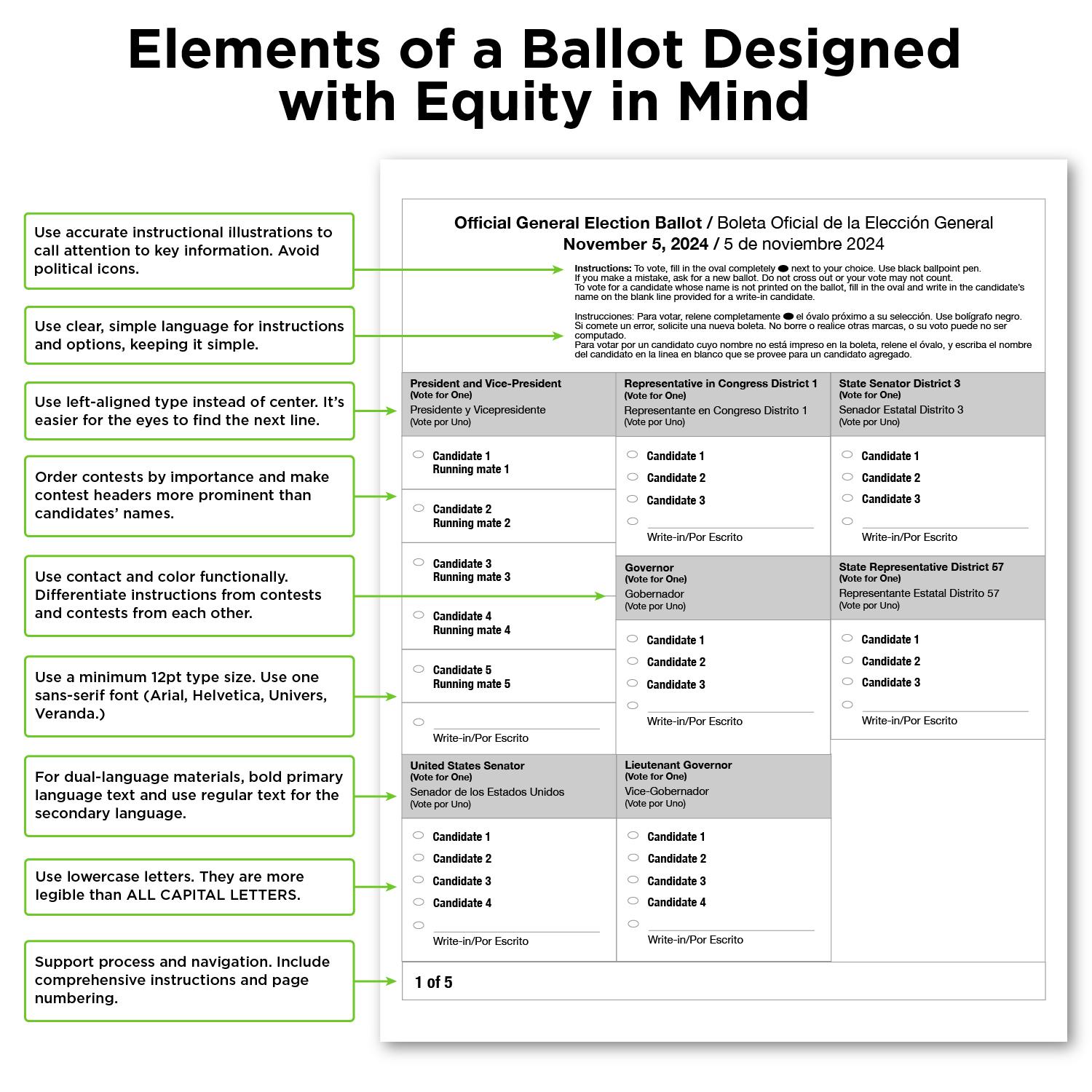
Fig1 caption:
Above are examples of scientifically tested design elements that can increase the likelihood of voters comprehending, completing, and submitting a ballot that will not be rejected or need fixing.