Unfinished Business: A Review of Public Comments on the EPA’s Cumulative Impacts Framework
This is an online version of the executive summary. A PDF of the full report can be found here. A PDF of the executive summary can be found here. A PDF of the appendix can be found here.
Cumulative impacts analysis evaluates the combined effects of multiple stressors and burdens—social, environmental, health, historical, cultural, and economic—to inform more comprehensive and equitable decision-making. After decades of efforts by advocates and experts, the U.S. Environmental Protection Agency (EPA) issued a new framework in November 2024 for the use of cumulative impacts in policymaking and requested public comment. Since January 2025, however, the Trump administration has made changes that undermine environmental justice and public health, including EPA’s ability to use the Cumulative Impacts Framework, and has not responded to any comments on the Framework.
The Union of Concerned Scientists (UCS) reviewed and analyzed public and Tribal community comments on the Framework. UCS also convened four meetings of experts to review the Framework. In the absence of federal leadership, this report will help inform efforts to advance cumulative impacts policies and practices.
People experience overlapping environmental and socioeconomic burdens and stressors that affect their health. Assessing and addressing these cumulative impacts (CI) require tools, processes, and policies that can incorporate this lived reality into environmental protection programs. In November 2024, the US Environmental Protection Agency (EPA) published its Interim Framework for Advancing Consideration of Cumulative Impacts (or CI Framework) and requested public comments. This CI Framework "provides EPA with a foundation to incorporate analysis and consideration of cumulative impacts into programmatic work, with the goal of achieving results that improve peoples' [sic] lives."
The EPA received 92 public comments on the CI Framework, including nearly 3,000 similar comments. It did not respond to the comments or state an intent to do so. The Union of Concerned Scientists (UCS), with independent researchers (formerly EPA staff), led a group with diverse expertise in synthesizing and reporting on the comments so that this report could be used by entities considering CI work.
A technical team from this group conducted a qualitative analysis of the public comments and extracted themes and subthemes. Once the technical team had drafted a report on the analysis, UCS led and facilitated four convenings with commenters and CI experts to verify our research against lived experience and enhance the report.
The public comments reflected five themes (as shown in Figure ES-1):
-
Requirements for CI consideration, including establishing new—and asserting existing—legal requirements, nonfederal decisionmaking, and evidence for regulatory overreach and underreach
-
Shaping and executing a CI program, including feedback on how agencies should ensure their goals are met, who should be at the table, what would trigger initiation, how intragovernmental agencies should coordinate, what embedded qualities and values should guide it, and what the rationale would be for the existence of CI programs
-
Ensuring desired outcomes, emphasizing that assessments inform decisions and resulting actions lead to positive outcomes
-
Conducting meaningful outreach and engagement, including diverse representation and actual influence, transparent and plain-language one-way communication, and reduced barriers for participation throughout program development and individual assessments
-
Developing CI assessments, including the necessary characteristics and the types of scientific exploration or data to include
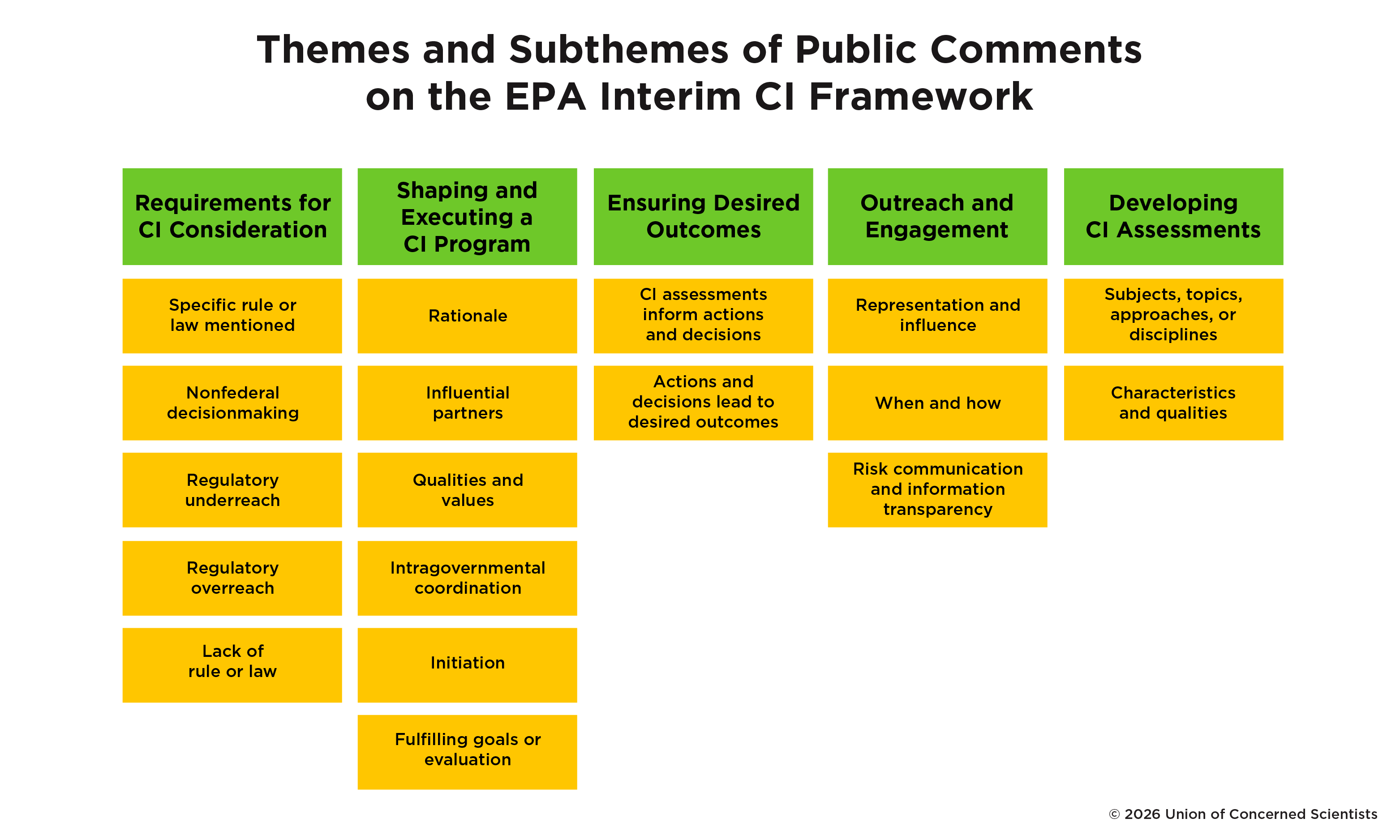
Note: These original themes and subthemes were used to code the comments. These phrases and words were shortened for clarity in some parts of this report or explained to describe their meaning. For example, “initiation” is described in the report as “initiation triggers,” and “regulatory overreach” is described in the figures as simply “overreach.”
Commenters were predominantly in favor of pursuing CI for research purposes. However, many commenters and all convening participants urged that CI assessments be tied to decisions to improve conditions in communities that are overburdened, sometimes disproportionately, with pollution. In support of this, commenters recommended clarifying the EPA's legal authority and avoiding underreach and overreach. Both commenters and convening participants suggested using the full extent of existing direct and discretionary regulatory authority, and—since much of environmental protection is source-specific—developing new statutory frameworks specifically informed by CI.
In their recommendations on legal requirements and overarching program guidance, the commenters and convening participants emphasized the need for accountability: accountability of those conducting the assessments to the reality of affected communities, accountability of those making decisions to those affected by the outcomes, and accountability of individuals and entities when goals are not met or community conditions are not improved.
Convening participants asserted that assessing and addressing CI can drive positive change in affected communities and that it is not new or theoretical. Commenters and convening participants understood CI as interdisciplinary and a practice requiring innovative ways to integrate qualitative and quantitative data, including lived experience and Indigenous Knowledge. Further, CI programs and assessments must include social determinants of health and multiple and disproportionate environmental risks.
Overall, commenters who support CI and the convening participants maintained that CI programs require cultural and procedural changes. Commenters and convening participants stressed that programs should be set up to track goal fulfillment, that those goals need to relate to improvements in overburdened communities, and that entities need to adapt their programs to ensure they remain effective and equitable.
To that end, they recommended having designated staff with clear roles and responsibilities and strong coordination across levels of government. They noted that one of the benefits of CI programs and assessments is efficient governance, because issues are not pushed to the next quarter or year, or into other departments, potentially causing delays and inaction.
Driving home this point, convening participants reflected that many of their partners assume environmental protections are informed by CI and are delivered to properly reflect how people and families live.
Commenters and convening participants strongly recommended that CI assessments be tied to decisions, and the decisions tied to actions that improve communities. Tying the results of CI assessments, such as estimations of multiple chemical exposures, to decisions requires the EPA to assign meaning to these metrics and indices. This assignment of meaning in turn requires novel methods rooted in professional judgment, science, and authentic community engagement.
Yet much unfinished business remains in requiring and crafting assessments that lead to pollution reductions in overburdened communities. Commenters and convening participants urged movement from providing a rationale for CI programs to implementing them. They also called for progress in evaluating outcomes.