Table of contents
Prompted by the development of data centers in Wisconsin, We Energies and other investor-owned utilities are investing in new electricity generation with unprecedented speed. Using loopholes in state regulations, the utility, along with what are known as independent power producers (IPPs), are circumventing the needs of the public as they acquire or construct plants powered by methane gas. Moreover, current regulatory processes bypass steps that would be particularly critical for ensuring that utilities both appropriately model the need for proposed plants and that they move toward a clean energy future for Wisconsin and its people by maximizing flexible load resources in planning.
As a large number of data center proposals sheds light on harmful impacts to consumers, Wisconsin's lack of forward-looking energy policy, on top of existing regulatory loopholes, could move the state a step away from robust energy resource planning. Lacking effective opportunities to scrutinize the proposed energy projects, ratepayers will be left at risk of paying for new power plants that may not be properly vetted—or even needed. And if those plants burn methane gas, consumers could pay the price with both their pocketbooks and their health (Chávez 2025).
We Energies' Generation Reshaping Plan
As part of its business, the utility company We Energies provides electrical service to areas of Wisconsin (We Energies, n.d.). Within its territory, two customers, Microsoft and Vantage, are developing hyperscale data centers; Vantage, in turn, plans to lease its centers to OpenAI and Oracle. Combined, the present and future plans for expansion could add up to five gigawatts (GW) of electricity to support these data centers (Clean Wisconsin 2025). As a point of reference, it took 120 years for We Energies' demand from all of its customers to reach 5 GW, enough to power 4.3 million Wisconsin homes. Of the proposed added demand, 3.9 GW is already planned (with the rest under consideration for further in the future).
To meet the demand it foresees, We Energies is rushing to construct or acquire large amounts of generating capacity (Schulz 2025). As part of that process, the state requires it to submit an application to the Public Service Commission of Wisconsin (PSCW) for each project it plans to build or buy. In fact, We Energies currently has 12 cases before the PSCW for acquiring or upgrading energy infrastructure, primarily to serve the electricity demand of Vantage and Microsoft data centers. Over 1 GW of We Energies' total planned generating capacity would come from new gas plants being built by Invenergy, an IPP.
The situation presents the PSCW with several dockets that it must review and consider individually rather than as a whole (see box). It also introduces an array of risks in terms of cost, grid reliability, and environmental harm. While the energy would primarily serve the data centers of large corporations, the impacts of expensive gas plants that emit harmful carbon emissions and pollutants may fall mostly on Wisconsin residents.
BOX. We Energies and the Regulators: A Step Forward and a Cautionary Note
A recent case before the Public Service Commission of Wisconsin, which covered significant ground, represents an important example of regulatory oversight.
The PSCW authorizes We Energies, as an investor-owned utility, to earn a return on equity for its infrastructure investments. The PSCW authorized this return in 2024, which is currently at 9.8 percent (PSCW 2024). This gives the utility an incentive to invest in large capital projects like building gas plants (Daniel 2025). We Energies has filed a new rate case application (Garvin 2026) and is seeking to increase its profit potential. Ultimately, the utility's customers see such costs reflected in their electric bills.
In May 2026, the PSCW issued its final decision regarding a "large load tariff" application that We Energies had submitted seeking a special rate structure for very large customers (a group that would, of course, include data centers) (PSCW 2026a). Prior to the decision, consumer advocates had identified several concerns with the original proposal (Chávez 2026a). In their decision, the commissioners responded and used their discretion as regulators to correct issues in order to protect ratepayers from unfair costs.
Despite that welcome decision, the scope of this single case cannot encompass all aspects of data center impacts. For example, the commissioners voiced concerns over transmission cost allocation, as that lies largely but not exclusively within federal jurisdiction (PSCW 2026b; Jacobs 2025). In another example, commissioners cannot impose certain requirements for data centers to use clean energy if that mandate does not exist in state law.
Protecting the Public When Utilities Add New Electric Facilities
In Wisconsin, two regulatory pathways exist as public utilities and IPPs seek to build or acquire generating capacity. One pathway pertains to building capacity and the other to buying it. Further, while utilities are responsible for distributing electricity to households and businesses via power lines, they can also build and operate their own generating capacity—for example, with gas plants or solar projects. IPPs can also construct energy projects, and they can sell electricity into the regional market. While IPPs and utilities follow similar processes for constructing new generating capacity, the regulatory approval process differs.
Building Capacity: Construction cases are filed when a utility or IPP wishes to build its own facility. Depending on the kind of facility, the commission considers two types of certificates (PSCW 2026c):
-
A Certificate of Authority (CA) applies to facilities below 100 MW of generating capacity.
-
A Certificate of Public Convenience and Necessity (CPCN) is for facilities with more than 100 MW of generating capacity. This case type applies to the construction project proposals discussed in this brief. (The CPCN process can also be used to build transmission lines.)
Buying Capacity: Buy/Sell cases are filed when a utility seeks to acquire all or part of an existing facility from another utility or an IPP. This can include buying a portion of generating capacity or even purchasing an entire facility. (Buy/Sell cases are also utilized to exchange service territory and customers.)
These regulatory processes are important steps for ensuring that utilities meet the electricity demands of all their customers at a reasonable cost and that they maintain reliability within the power grid. However, several concerns arise in regard to the current regulatory structure. These include the circumvention of requirements to prioritize public need, policy gaps that leave room for public harm, and the rapid expansion of data centers—all of which threaten to increase electricity costs and delay the transition to a cleaner grid.
Evading Scrutiny? Two Gas Plant Proposals
In the coming months, the PSCW will review several We Energies proposals. Among these are proposals regarding two new methane gas plants: the 324 MW Foundry Ridge gas plant and 1,186 MW Red Oak Ridge gas plant. Together, these plants would generate nearly enough electricity to power 1 million Wisconsin homes (Rogers, Chávez, and McNamara 2024).
Significantly, We Energies is not proposing to build these two large plants. Instead, Invenergy, an IPP, seeks to build them in Southeast Wisconsin. And one result of that distinction is that it disadvantages the public in the review processes for the two cases. State laws limit how the PSCW can factor public need into cases like these and could result in significant risk for Wisconsin communities.
As part of the plan, Invenergy has filed CPCN applications with the PSCW seeking approval for each of the two construction projects. Separately on the commission's docket, We Energies has submitted corresponding Buy/Sell applications to acquire those two gas plants. As stated in the Buy/Sell applications, We Energies plans to use this new generating capacity to meet what it terms "substantial data center load additions" (PSCW 2025).
Wisconsin law obliges public utilities to provide an adequate supply of electricity to their customers, as well as to prioritize the most cost-effective options to keep rates reasonable (Wis. Stat. §196.491(3)(d), n.d.). They must outline these justifications in their applications, and the PSCW must consider such factors in its decisions. However, such rules do not bind IPPs. While the PSCW must review IPPs' applications, the statutory requirements differ from those for utilities. Significantly, IPPs have no legal obligation to serve the public. According to the statute, they need not prove to the commission that their proposed facility would meet the public's electricity needs, nor may the commission consider, among other things, certain economic factors in its decision. This difference in regulatory requirements is because IPPs are independent companies rather than public-serving entities. Nevertheless, IPPs still must abide by other construction requirements, including environmental reviews by other agencies.
The PSCW is required to consider each decision—in Invenergy's construction cases and in We Energies' Buy/Sell cases—individually. Initially, the commissioners will decide whether to grant Invenergy approval to construct the gas plants. They will consider the merits of Invenergy's application and testimony as well as the testimony of other intervening parties, but their final decision cannot consider arguments based on the needs of the public. Also, there is no overall plan or consideration of what policy goals apply in this phase of capacity expansion—for example, whether the expansion dilutes the relevance of any clean energy target. This leaves little room for intervenors to advocate for their communities, and it limits the scope for considering the realistic impact of these gas plants.
Next, the PSCW will review We Energies' applications to purchase the gas plants. In these cases, because We Energies is a public utility, the needs of the public are within the scope of arguments the commissioners can consider. The evident limitation is that the intervening parties are no longer arguing over whether the gas plants should be built, but rather whether We Energies should move forward with purchasing them.
This complex process represents a lost opportunity to discuss the merits of meeting the utility's needs with other sources of power including clean energy, or with flexible load management strategies like demand response. In essence, the fragmented nature of the cases isolates the process of constructing large amounts of harmful methane gas--fired capacity from the necessary assessment of impacts to the public. It restricts the power and voice of ratepayers and excludes opportunities for debating which type of power source is best. For Wisconsin energy consumers and their communities, these barriers result in less transparency, fewer opportunities for advocacy, and, ultimately, an unfair playing field when they are up against the interests and immense resources of data center developers and large utilities.
An important consideration should be how data centers powered by methane gas put public health and the environment at risk. A recent Union of Concerned Scientists analysis found that, under current policies, Wisconsin would use mostly methane gas to meet data center electricity demand (Chávez 2026b). The data centers' added demand on Wisconsin's electricity grid could result in 41 million tons of cumulative carbon dioxide emissions by 2035, leading to negative health impacts and climate damages. University of Wisconsin-Madison researchers focused specifically on the impact of the Red Oak Ridge and Foundry Ridge proposals. They found that exposure to particulate matter emissions from these plants could result in $1.38 billion in health harms and over 118 premature deaths over the 30-year lifetime of the plants (Mailloux et al. 2026).
In considering public health impacts, if a proposed facility would meet air pollution permitting standards set by the state's Department of Natural Resources, the PSCW cannot determine that a proposed facility would have an undue adverse impact on matters like public health and welfare because of the impact of air pollution. This language in state law further limits the public's ability to call for less harmful alternatives in their arguments in favor of public need, including those pertaining to health and safety.
The Role of Independent Power Producers
It is important to note that the lighter hand of regulation on Independent Power Producers can benefit the public. IPPs and the process by which they deploy energy projects cannot be characterized solely under the conditions for the two proposed methane gas plants. In fact, removing the IPP pathway from regulatory processes would likely harm the state's ability to incorporate new clean energy into its portfolio.
IPPs and the approval process for their projects creates a more efficient path to adopting and integrating renewable energy. According to data available through the PSCW, since 2018, IPPs have proposed 27 projects that would introduce clean technologies, including wind, solar, and storage, into Wisconsin's grid (Figure 1) (PSCW, n.d.). In that same timeframe, We Energies has relied on Buy/Sell proceedings to acquire some of the IPP-developed facilities, even if it has not proposed its own clean energy construction projects. An efficient approval process by which IPPs construct and sell renewable energy capacity helps the state increase its share of clean energy while meeting the growing electricity demands of all its customers.
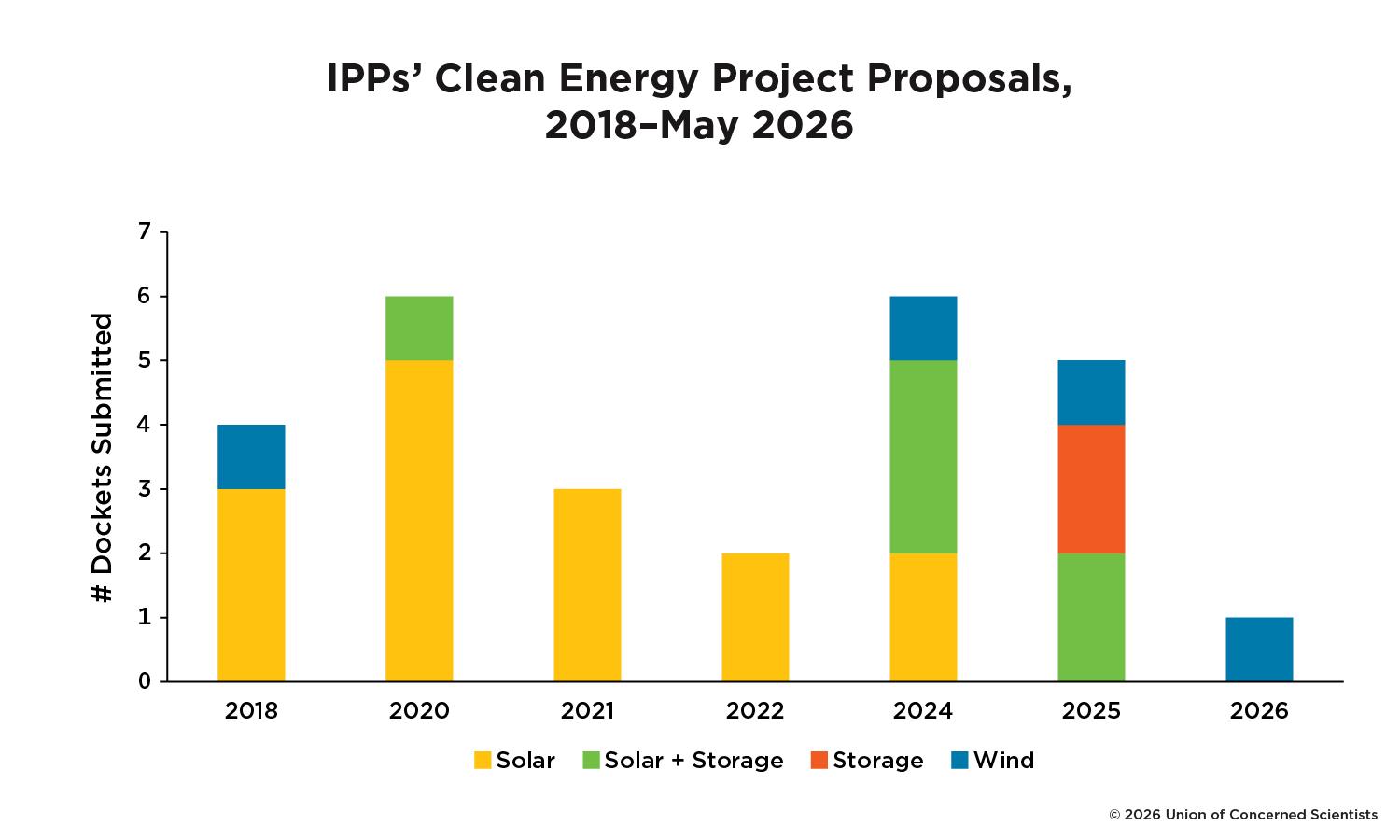
The recent operation of this IPP approval process is crucial to understanding the larger context for studying gaps in energy policy. The process is designed to expand the options for meeting energy demand, thereby creating a more diverse portfolio of resources. Renewables offer a cleaner way to meet the grid's electricity needs and help avoid the substantial health and climate risks associated with fossil fuels. In fact, Wisconsin's 2021 Energy Priorities Law set in motion a mandate for utilities and state agencies to prioritize cost-effective renewables (Wis. Stat. § 1.12 2021). Likewise, in assessing the best use for the IPP approval process, decisionmakers can pay close attention to how to use that process to bring different resources onto the grid, taking into consideration the concerning implications of vast methane gas additions.
Shedding Light on Policy Gaps
The complexity of approval processes are unlikely to be resolved over the course of one or two cases before the PSCW. Just as troubling, deep issues around the state's overreliance on fossil fuels are rooted in the compounding effects of other policy gaps amid the influx of power-hungry data centers.
Data centers present Wisconsin not only with massive amounts of new electricity demand but also with a degree of uncertainty that makes energy planning into the future more difficult and riskier than ever.
Wisconsin lacks two types of policy that can introduce robust preparedness and sustainability into decisionmaking that makes utilities more accountable to their ratepayers.
-
An active clean energy target written into law establishes objectives around transitioning to clean energy.
-
A workable long-term planning requirement, such as an Integrated Resource Plan (IRP), creates a long-term perspective on resource planning.
Wisconsin did establish a Renewable Portfolio Standard (RPS) of achieving 10 percent renewable energy, but it did so in 2005. The RPS has not been updated since then even though the state has long surpassed that modest goal.
With an active clean energy target or a long-term planning requirement at the ready, Wisconsin could plan for and adapt to predictable and unforeseen demands on the grid. With neither policy in place, Wisconsin ratepayers are vulnerable to the changing tides of profit-driven interests. Instead of a holistic portfolio of planned grid investments, reviewed and discussed on a planned timeline, regulators and the public face stacks of individual, one-off proposals from utilities chasing data center demand, including some proposals that may be highly speculative. Instead of the state progressing on a steady path to a healthy and clean energy future, ratepayers bear the costs of paying for gas and coal with their wallets and health (Clemmer et al. 2026).
Wisconsin's lack of forward-looking energy policy not only makes a clean energy transition much more difficult, it is also bad for ensuring a just and equitable future. When lawmakers delay, conditions are ripe for powerful entities to exploit the system. The building capacity vs. buying capacity issue is one example, and the recent use of that process to bring more harmful methane gas plants to the state exposes the larger risks that result from a lack of comprehensive energy laws. Data center developers can take advantage of loose energy laws to extract maximum power from the grid, regardless of the consequence to surrounding communities. And utilities continue to have incentives to chase this demand and profit from large investments.
Energy Pathway for the People
Data centers are not the sole reason for ongoing energy problems, but their emergence has thrown a harsh spotlight on gaps in policy (McNamara 2026). If ignored and unaddressed, the gaps will continue to harm and overburden the people of Wisconsin. With or without data centers, Wisconsin urgently needs proactive laws that are transparent about the true costs of overreliance on fossil fuels.
Wisconsin's pathway to energy planning must prioritize the public in at least three ways:
Keep powerful entities like utilities and data centers accountable to Wisconsin communities.
False narratives of urgency, driven by corporations, should not hamper the public's ability to participate in decisionmaking. Decisionmakers must institute policies that serve the public better. They should close regulatory gaps, including the ability of IPPs to construct costly and harmful fossil fuel power plants without considering public need.
Replace today's excessive number of individual applications, considered in individual decisions, with an Integrated Resource Plan (IRP) or other comprehensive energy resource plan.
Until Wisconsin formally adopts an IRP, regulators should strive to review the merits of interrelated cases, such as the ones under We Energies' generation reshaping plan, holistically and with robust consideration of the cumulative impacts to the public and to Wisconsin's electric grid.
In prioritizing the adoption of strong clean energy targets in state law, include measures for environmental justice, thereby ensuring a sustainable roadmap for achieving access to clean and affordable energy for all.
State law must ensure that air permitting standards do not preclude the ability of regulators to consider the health and climate impacts of carbon emissions associated with project proposals.
Day by day, the public, especially at the local level, grows increasingly distrustful of data center developers, utilities, and the elected bodies that obscure decisionmaking processes and leave communities to fend for themselves (Herken 2026). Public regulatory mechanisms that bypass comprehensive review to advance the development of large sources of pollution will only further erode public trust.
Wisconsin communities should not be limited in their capacity to advocate for a better energy future. Today's fragmented assortment of cases dilutes and complicates the process of reviewing proposals in an organized fashion. Restoring public trust must begin with true accountability through enforcing a comprehensive energy planning policy. And because implementing such measures thoughtfully can take time, Wisconsin's leaders should resist data center developers' claims of urgency.
Looking beyond transparency, the state needs better options to steady its course through sudden and unexpected energy obstacles. Just as important, it needs to prepare for the rise in electricity demand that is coming regardless of data centers. An IRP, as a long-term planning strategy, would put the needs of its people first. A commitment to clean energy is a multi-generational promise—to people, to communities, and to our entire planet.
Authors
María Fernanda Chávez is a senior energy analyst in the UCS Climate and Energy Program.
Acknowledgments
This project was made possible by the generous support of The Joyce Foundation, and UCS members.
The author would like to thank Cassie Steiner, Senior Campaign Coordinator at the Sierra Club-Wisconsin Chapter, and Dan Ebert, Managing Partner at 5 Lakes Energy, for providing external review and valuable recommendations, and UCS colleagues Paul Arbaje, Victoria Coleman, Jeff Deyette, James Gignac, Mike Jacobs, Eric Schulz, Christina Stone, Daela Taeoalii-Tipton, Heather Tuttle, and Bryan Wadsworth for thoughtful feedback and support. Special thanks go to Marc S. Miller for expert editing.
Organizational affiliations are listed for identification purposes only. The opinions expressed herein do not necessarily reflect those of the organizations that funded the work or the individuals who reviewed it. The Union of Concerned Scientists bears sole responsibility for the project's contents.
References
Chávez, Maria. 2025. "New Analysis Shows Public Health Impacts of Proposed Gas Plants in Wisconsin." The Equation (blog). January 16. https://blog.ucs.org/maria-chavez/new-analysis-shows-public-health-impacts-of-proposed-gas-plants-in-wisconsin
Chávez, Maria. 2026a. "To Understand Rising Energy Costs in Wisconsin, Follow the Data Center Bread Crumbs." The Equation (blog). January 13. https://blog.ucs.org/maria-chavez/to-understand-rising-energy-costs-in-wisconsin-follow-the-data-center-bread-crumbs
---------. 2026b. Wisconsin Data Center Power Play. Cambridge, MA: Union of Concerned Scientists. https://www.ucs.org/sites/default/files/2026-01/Data-Center-Power-Play-Wisconsin_0.pdf
Clean Wisconsin. 2025. "AI Data Centers in Wisconsin Will Use More Energy than All Homes in State Combined." Press Release, September 16. https://www.cleanwisconsin.org/ai-data-centers-in-wisconsin-will-use-more-energy-than-all-homes-in-state-combined
Clemmer, Steve, Maria Chávez, Samuel Dotson, James Gignac, Sandra Sattler, and Lee Shaver. 2026. Data Center Power Play: How Clean Energy Can Meet Rising Electricity Demand While Delivering Climate and Health Benefits. Cambridge, MA: Union of Concerned Scientists. https://doi.org/10.47923/2026.16051
Daniel, Joe. 2025. "Rebalancing 'Return on Equity' to Accelerate an Affordable Clean Energy Future." RMI, February 21. https://rmi.org/rebalancing-return-on-equity-to-accelerate-an-affordable-clean-energy-future
Garvin, Robert M. 2026. Letter to Cru Stubley, Secretary to the Wisconsin Public Service Commission, Re: 5-UR-112—Application of Wisconsin Electric Power Company and Wisconsin Gas LLC for Authority to Adjust Electric, Steam, and Natural Gas Rates. April 1, 2026. https://apps.psc.wi.gov/ERF/ERFview/viewdoc.aspx?docid=586105
Herken, Olivia. 2026. "Data Centers Have Staying Power as a Wisconsin Election Issue." Cap Times, April 17. https://captimes.com/news/government/data-centers-have-staying-power-as-a-wisconsin-election-issue/article_60c1b29f-677d-4b9b-9765-a8e33cd91ec1.html
Jacobs, Mike. 2025. Loophole Costs Customers Over $4 Billion to Connect Data Centers to Power Grid. Cambridge, MA: Union of Concerned Scientists. https://www.ucs.org/sites/default/files/2025-09/PJM%20Data%20Center%20Issue%20Brief%20-%20Sep%202025.pdf
Mailloux, Nicholas, Mokshda Kaul, Morgan Edwards, and Jonathan Patz. 2026. Air Quality and Health Effects of the Foundry Ridge and Red Oak Ridge Energy Centers. Madison, WI: Climate Solutions for Health Lab. https://www.wpr.org/wp-content/uploads/2026/03/Foundry-Ridge-Red-Oak-Ridge-Analysis_2026_02-2.pdf
McNamara, Julie. 2026. "Electricity Bills Are High. Trump Administration Policies Are Set to Make Them Soar." The Equation (blog). March 18. https://blog.ucs.org/julie-mcnamara/electricity-bills-are-high-trump-administration-policies-are-set-to-make-them-soar
PSCW (Public Service Commission of Wisconsin). n.d. "PSCW Case Management System." Accessed May 12, 2026. https://apps.psc.wi.gov/APPS/dockets/newapp.aspx
PSCW (Public Service Commission of Wisconsin). 2024. "Joint Application of Wisconsin Electric Power Company and Wisconsin Gas LLC for Authority to Adjust Electric, Natural Gas, and Steam Rates, 5-UR-111." December 19, 2024. https://apps.psc.wi.gov/ERF/ERFview/viewdoc.aspx?docid=527450
PSCW (Public Service Commission of Wisconsin). 2025. "Application of Wisconsin Electric Power Company for Approval to Acquire an Ownership Interest in the Natural Gas-Fired Red Oak Ridge Energy Center and Associated Facilities in the in the Town of Paris, Kenosha County, Wisconsin, 6630-BS-104." November 5, 2025. https://apps.psc.wi.gov/ERF/ERFview/viewdoc.aspx?docid=566879
PSCW (Public Service Commission of Wisconsin). 2026a. "Application of Wisconsin Electric Power Company for Approval of its Very Large Customer and Bespoke Resources Tariffs. Final Decision." May 21, 2026. https://apps.psc.wi.gov/ERF/ERFview/viewdoc.aspx?docid=591873
---------. 2026b. "PSC Commission Meeting 4/24/2026." Video recording. https://www.youtube.com/watch?v=M1rOsztwB9c
---------. 2026c. "Power Plant Review Process." https://psc.wi.gov/SiteAssets/PowerPlantReviewProcess.pdf
Rogers, John, Maria Chávez, and Julie McNamara. 2024. "UCS Gas Plant Alternatives Tool." Harvard Dataverse, UCS Research Data. October 11. https://doi.org/10.7910/DVN/UN27KB
Schulz, Joe. 2025. "We Energies Hopes to Add Almost 3GW to the Electric Grid to Help Meet Data Center Demand." Wisconsin Public Radio, November 5. https://www.wpr.org/news/we-energies-add-3gw-electric-grid-data-center-demand
We Energies. n.d. "We Energies." Home page. Accessed [June 14, 2026]. https://www.we-energies.com
Wisconsin Statutes §1.12 2021. "Energy Priorities Law." https://docs.legis.wisconsin.gov/statutes/statutes/1/12
Wisconsin Statutes. §196.491(3)(d). "Strategic Energy Assessment; Electric Generating Facilities and Transmission Lines; Natural Gas Lines." Accessed May 8, 2026. https://docs.legis.wisconsin.gov/statutes/statutes/196/491/3/d