This is an abridged online version of the Methodology and Appendices. A full PDF of the methodology and appendices can be found here. The Attacks on Science Tracker can be found here. A full list of definitions, concepts, and agencies reviewed is available here.
HIGHLIGHTS
Since Inauguration Day on January 20, 2025, the second Trump administration has launched a systemic attack on the federal scientific enterprise. The Union of Concerned Scientists (UCS) has tracked attacks on science at the federal level since 2001, but the pace and scope of attacks under this new administration is truly unprecedented. In response to this rapid and broad-ranging dismantling of federal scientific structures, the Center for Science and Democracy at UCS has evolved its methodology to meet the current moment. This methodology, informed by UCS's longstanding work tracking attacks on science, includes a new approach to collecting, screening, and analyzing data to identify and categorize attacks on science.
Based on previous experience tracking attacks on science, UCS researchers programmed R scripts, through an iterative process, to automate the collection and organization of news coverage. The articles surfaced through this process are reviewed and analyzed by researchers to identify and categorize attacks on science. This system will allow UCS to more consistently and comprehensively track attacks on science and potential violations of scientific integrity in perpetuity.
Attacks on Science Tracker Methodology
The Union of Concerned Scientists (UCS) has been tracking attacks on science and advocating for scientific integrity (SI) protections since 2001 (Desikan 2023; Shulman and Gottfried 2004; UCS 2025). In brief, attacks on science are instances of political interference in federal science (UCS 2025). Attacks on science and scientific integrity are closely linked; not all attacks (as UCS defines them) are considered violations of scientific integrity, but potential SI violations are a form of political interference in science.
UCS defines scientific integrity as keeping science independent from political interference and using the best available science (Phillips 2025) to inform policy and decisionmaking (Barbati-Dajches 2025; Goldman, Reed et al. 2017). UCS defines potential SI violations as attacks on science that result in the suppression, delay, or alteration of scientific studies or data or that result in censorship, retaliation, or increased scrutiny of federal scientists and their work (see, for example, Goldman, Reed et al. 2017).
Starting in January 2025, the newly inaugurated second Trump administration began a systemic attack on the federal scientific enterprise, characterized by an increased scope and pace of attacks on science compared with what UCS had tracked previously. To better capture the greater number and types of attack, the Center for Science and Democracy (the Center) developed a new methodology to track and analyze attacks on science and potential SI violations. The evolved methodology, informed by UCS's longstanding work around attacks on science, includes a new approach to collecting, screening, and analyzing data to identify and categorize attacks on science. This approach is designed to systematically capture a more comprehensive breadth of attacks in perpetuity.
Initial Human-Driven Data Collection and Organization
As of January 2025, UCS has defined "attacks on science" as actions, statements, or decisions originating from an elected official or political appointee in a federal agency that result in the censoring, manipulation, forging, or misinforming of scientific data, results, or conclusions conducted within the government or with federal funds (Minovi et al. 2025). On January 20, 2025, a researcher in the Center began compiling news articles that could potentially meet that new UCS definition. Original data collection began by searching daily news email alerts, supplemented with articles from other publications. The Center used this human-driven process while developing an automated system to collect, screen, and organize attack on science data.
See Minovi et al. (2025) for more information on the human-driven data collection and organization of news articles.
Automated Data Collection and Screening
Starting on December 20, 2025, the Center for Science and Democracy automated data collection and organization with a series of scheduled R scripts that collect RSS feeds from 13 news outlets, screen articles for search terms indicative of a potential attack on science, and organize screened articles into a spreadsheet to be analyzed by trained human coders (Figure 1). Researchers used Microsoft's Task Scheduler to schedule the R scripts as per the timeline detailed on UCS's GitHub page.
The Center adheres to "polite principles" with the automated navigation and targeted URL scraping of web content (Perepolkin 2023; Wickham et al. 2023). These principles include asking for data only once, accessing websites with institutional or personal subscriptions, appropriately citing sources, storing data locally, and promptly deleting data after analysis. Researchers also use crawl delays and schedule targeted URL scraping during low web traffic hours to avoid overwhelming website capacity.
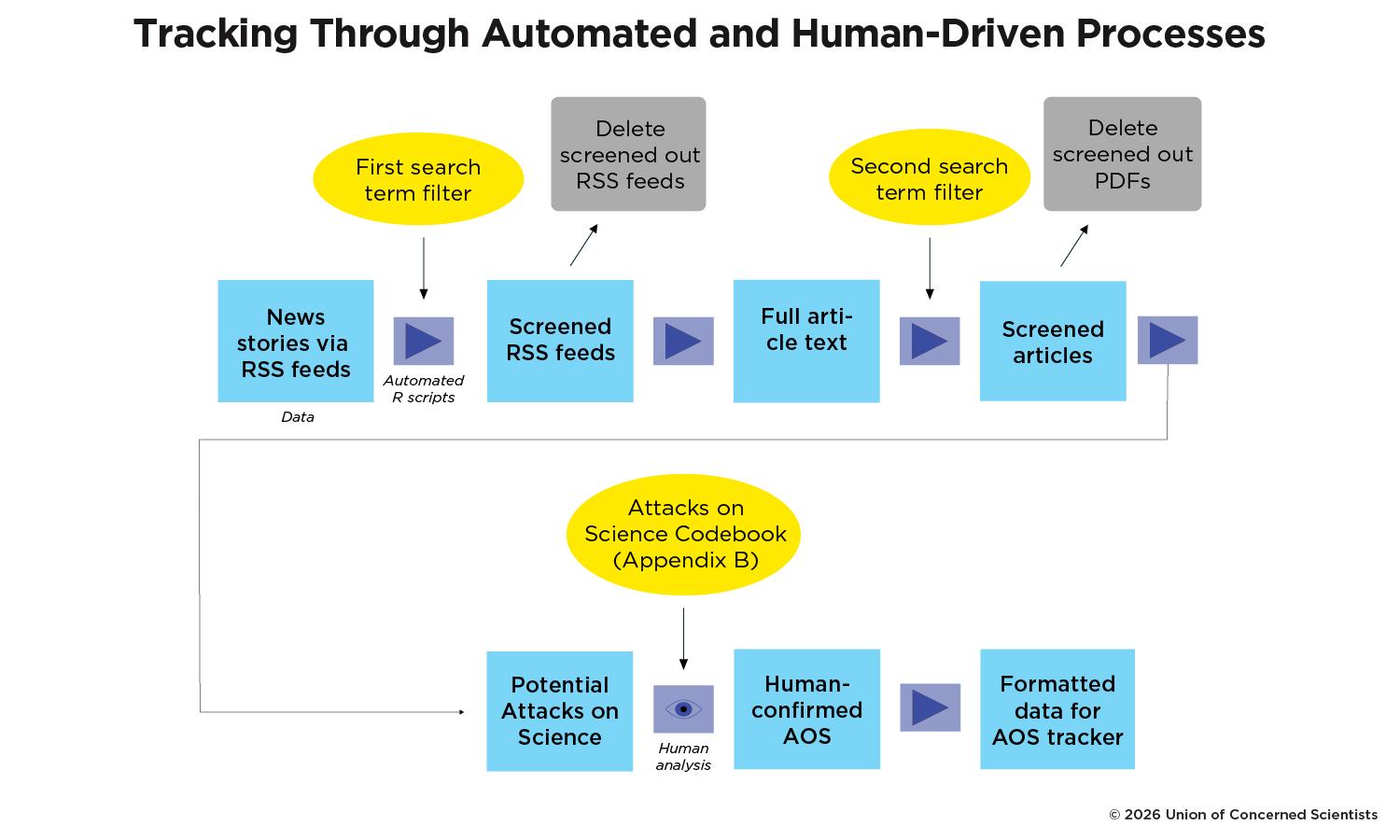
Note: AOS = Attacks on Science. "Potential Attacks on Science" are news articles that pass both search term filters and then go through the subsequent three data processing steps before human coding. "Human-confirmed AOS" are attacks that human coders have confirmed the presence of and categorized by type, topic, and completion stage.]
Data Collection with RSS Feeds
Researchers in the Center programmed an R script to run at the same time every day to chronologically compile news outlet RSS feeds from the previous day. RSS feeds typically include a short description of each article generated by the news outlet, along with each article's headline and date of publication. Researchers chose outlets based on three criteria:
-
The public accessibility of outlets' content;
-
The prevalence of attacks on science in news coverage---determined from the human-driven data collection process; and
-
In alignment with polite principles, outlets' allowance of targeted URL scraping.
Thus, RSS feeds are pulled from The Hill, AP News, STAT News, all E&E News publications (ClimateWire, E&E Daily, E&E News PM, EnergyWire, GreenWire), Government Executive, NBC News, NPR, and the Democracy news from Stateline.
Appendix B. Attacks on Science Codebook and Coding Procedure
Version 12; Last Updated April 27, 2026
Coding Process
-
Open the coding spreadsheet to begin.
-
Articles already coded are identified with initials in the "Coders" column. Identify an article that still needs to be coded and, in the "Coders" column, write your initials to show other coders that you are coding that row of data.
-
Follow the URL (in column labeled "LINK") to read the articles.
-
Identify whether there is at least one attack on science based on the definition (see the next section) in the column labeled "AOS PRESENCE."
o If yes, change the "0" in that column to "1."
-
If an attack on science is present, please identify which category (or categories) the attack belongs to based on the definitions in the following pages (e.g., agency appointments, rules/regulations/orders).
o If an attack belongs to a category, please change the "0" in the respective column to a "1."
o When coding the type of attack, ask yourself whether the action, statement, or decision being described:
-
Originates from an elected or politically appointed person in a federal agency or department AND
-
Results in the censoring, manipulation, forging, or misinforming on scientific data (inclusive to mean raw or processed data, analysis process/methodologies, or results/conclusions)
If the action, statement, or decision does not meet both criteria, it cannot be considered an attack on science.
o Typically, news articles review other attacks on science that previously occurred (i.e., "sharing context"). Do your best to code the attack type(s) that are the focus of the article to minimize duplicate attacks in the dataset.
o In addition to articles having a "main focus" attack type, some articles also describe an attack's direct implications. For example, an article may describe how grant funding at an agency is halted because of political motivations (e.g., Politicization of Grants and Funding), and data collection on relevant studies may halt as a result (e.g., Data Collection). It is ideal to code both types of attack if they are described this way.
-
-
If an attack on science is present, please identify which topic(s) the attack correspond(s) to (e.g., climate change, health & safety).
o If an attack belongs to a category, please change the "0" in the respective column to a "1."
-
If an attack on science is present, please identify whether it has been threatened or completed based on the definitions below.
o "Threatened" and "Completed" are two separate variables to assess the stage of an attack. Each attack type has been developed with a "target" in mind that identifies who the attack will most immediately impact. A completed attack means that the article covering the attack describes the target as feeling its tangible impact. For example, layoffs in a science agency would be completed once the first person is laid off.
o These columns should correspond to the attack types chosen in the previous columns, as well as the target of the impact identified under each type of attack.
o Please change the "0" in the respective column to a "1" if an attack is threatened or completed under the respective column. An attack cannot be both threatened and completed.
-
If an attack type, topic, or completion status is not explicitly stated in the article or if you are not sure if it is present, err on the side of not coding it.
-
"Summary" articles either describe attacks that happened in the past or describe attacks in the context of others. These are distinct from articles that "break" new attacks on science. Do not code attacks presented in summary articles. A good rule of thumb is to not code attacks described in articles if the attacks occurred more than three days prior to publication. This excludes instances in which outlets publish attacks on science that were gathered through Freedom of Information Act (FOIA) requests and that were previously unknown to the public.
Scope of Work
Moving forward, the scope of our work on Attacks on Science (AOS) will encompass an action, statement, or decision that:
-
Originates from an elected or politically appointed person in a federal agency or department; and
-
Involves the misuse (or noticeable absence) of science in the federal government or scientific work that receives federal funding.
Where the more general definition of an "attack on science" is an action, statement, or decision that results in the censoring, manipulation, forging, or misinforming on scientific data (raw or processed), analysis processes/methodologies, or results and conclusions conducted within the federal government or with federal funds.
"Attacks on science" can span many areas, topics, and types. The Center focuses on attacks on science in three main areas:
-
Attacks on science in federal processes;
-
Attacks on scientific research; and
-
Attacks on scientists.
An attack can be coded as more than one category (e.g., Scientific Advisory Committee/Board AND Politicization of Grants and Funding) and as more than one topic (e.g., Climate Science AND Health & Safety). However, an attack can only be coded as "threatened" OR "completed."
Codebook: Types of Attack on Science
Category 1: Attacks on Science in Federal Processes
Category Definition: Describes the misuse, absence, and/or contradiction of the best available science [or "the most reliable, valid, up-to-date, and relevant empirical knowledge" (Phillips 2025)] in federal processes, groups, or positions in which science should intuitively be consulted. Three types of attack on science in federal processes are in regard to Agency Appointments, Rules/Regulations/Orders, and Scientific Advisory Committees/Boards.
Agency Appointments
-
A person with an on-record history of anti-science attitudes and/or behaviors (i.e., rejects or ignores the best available science, scientific consensus, scientific methods, or scientific principles) is appointed or nominated to a federal agency or committee.
-
This does not include people with a lack of experience or qualifications or people with conflict of interests not explicitly related to science.
Target of this attack type = the people who are overseen/working with the person nominated or appointed
-
"Threatened" instances of agency appointments would include either the consideration of nominating someone with history of anti-science attitudes OR nominating someone with history of anti-science attitudes, but the source article qualifies that the person is not yet in an acting capacity (for example, because the person has not started the position or has not left their previous job).
-
"Completed" instances of agency appointments would include someone being nominated and in an acting capacity OR someone confirmed and appointed to the position. Anything up to these specific outcomes would be considered "threatened."
Rules/Regulations/Orders
-
Congress, a federal agency, or a federal commission enacts a rule, regulation, order, legislation, directive, or otherwise official federal decision that is anti-science (i.e., rejects or ignores the best-available science, scientific consensus, scientific methods, and/or scientific principles), OR
-
Congress, a federal agency, or federal commission rescinds, refuses to enforce, or delays the finalization of a rule, regulation, order, legislation, directive, or otherwise official federal decision that is informed by the best available science.
Do not code to categorize internal agency guidance that is being used to describe a different attack on science (e.g., an internal agency memo saying that the agency will no longer fund research on public health effects of climate change [politicization of grants and funding]).
One example of this attack type would be a political appointee (e.g., the Secretary of Health and Human Services) directing scientists to conduct an anti-science study (e.g., to study the debunked link between vaccines and autism) despite existing scientific consensus of the contrary.
Target of this attack type = entities (e.g., members of the public, animals, the environment) that are affected by the threatened or completed rule, regulation, or order
-
"Threatened" instances of rules/regulations/orders would include a bill being introduced, written, voted on; a regulation or rule being written, drafted, or posted for public comment in the Federal Register; a rule proposed to be modified; and a signed executive order.
-
"Completed" instances of rules/regulations/orders would include delaying the effective date of rules; a final rule is published; or a law is enacted, finalized, or takes effect. Anything up to these specific outcomes would be considered "threatened."
Scientific Advisory Committees/Boards
-
The composition of a scientific advisory committee/board is changed or dissolved to reduce the number of scientists, OR
-
Conflicts of interest in a scientific advisory committee/board are increased, not acknowledged, or not made public, OR
-
Meetings or convenings of a scientific advisory committee/board are disrupted or delayed.
NOTE: This category only applies to federal advisory committees (FACs) classified as scientific/technical advisory committees in the online FACA database.
Target of this attack type = the members of the scientific advisory committee/board
-
"Threatened" example of scientific advisory committees/boards: An official suggests that a scientific advisory committee should be reset or cancelled.
-
"Completed" instances of scientific advisory committees/boards would include a reduction in the number of scientists serving on the scientific advisory committee/board (including if the board's composition is changed or dissolved to reduce the number of scientists); conflicts of interest in the committee are increased, not acknowledged, or not made public; its meetings or convenings are disrupted or delayed. Anything up to these specific outcomes would be considered "threatened."
Category 2: Attacks on Scientific Research
Category Definition: This category concerns any research conducted, or data collected/analyzed, by federal scientists or funded by the federal government. Any actions, statements, or decisions related to these types of attack must originate from an elected or politically appointed official in the federal government. Four types of attack on scientific research are Altering Study Results, Data Accessibility, Data Collection, and Politicization of Grants and Funding.
Altering Study Results
Editing, misrepresenting, or manipulating the data processing, data analysis, or results of a scientific study, or the scientific weight of evidence, including that within reports, publications, or scientifically informed guidance.
Target of this attack type = those accessing or using the study
-
"Threatened" examples: The administration is considering misrepresenting scientific consensus in an upcoming report or analysis; the administration is pressuring scientists to alter study results to support a predetermined conclusion.
-
"Completed" instances of altering study results would include reports of editing, misrepresenting, or manipulating the data processing, analysis, or results of a scientific study, or the scientific weight of evidence (including within reports, publications, or scientifically informed guidance). Anything up to these specific outcomes would be considered "threatened."
"Completed" examples: Evidence of identification of data fabrication or manipulation in a government analysis; studies are designed or altered to support a predetermined conclusion; agency misrepresents scientific consensus in report.
Data Accessibility
Eliminating or minimizing the availability and accessibility of publicly available scientific data or information, including that within reports, publications, or scientifically informed guidance.
Target of this attack type = those accessing or using the reports, publications, or scientifically informed guidance
-
"Threatened" example: An agency creates an internal review process that could prevent manuscript publication or data sharing.
-
"Completed" instances of data accessibility would include evidence of eliminating or minimizing the availability or accessibility of publicly available scientific data or information (including within reports, publications, or scientifically informed guidance). Anything up to these specific outcomes would be considered "threatened."
"Completed" examples: Scientific data, databases, or government reports are inactivated or removed from websites.
Data Collection
Halting or modifying (after the event) collection in a scientific study.
Target of this attack type = those who are collecting data being halted or their work modified
-
"Threatened" example: Federal funding disruptions might interfere with ongoing data collection, but funding has not yet stopped.
-
"Completed" instances of data collection would include evidence of halting, delaying, or modifying data collection of a scientific study. Anything up to these specific outcomes would be considered "threatened."
"Completed" examples: Reports of grant terminations or federal funding disruptions halting or impeding data collection.
Politicization of Grants and Funding
Federal funding for research is withheld, dictated, or eliminated based on blatant political motivations. This does not include when research entities are dissolved or terminated unless politicized federal funding is explicitly mentioned.
Target of this attack type = the funding applicants and awardees
-
"Threatened" examples: Administration has created and may be employing lists of forbidden words in screening federal grant applications; there are delays in hearing back about grant applications or funding.
-
"Completed" instances of politicization of grants and funding would include evidence of federal funding for research being withheld, dictated, delayed, or eliminated. Anything up to these specific outcomes would be considered "threatened."
"Completed" examples: Federal grants on topics that have been deemed "prohibited" by political officials (e.g., equity, diversity, environmental justice, LGBTQ+) are suspended, terminated, or denied.
Category 3: Attacks on Scientists
Category Definition: The title "federal scientist" encompasses any person who is involved in scientific review, inquiry, or research and is also either employed by the federal government or whose research is funded by federal funds. This does notinclude members of federal advisory committees. Four types of attack on scientists are Censorship, Losing Positions, Restrictions from Professional Engagement, and Targeting Scientists Based on Identity.
Censorship
-
Federal scientists are unable to communicate externally their scientific findings or expertise due to direct orders, intimidation, or perceived harm, OR
-
Federal scientists' external messages are controlled to the point that they are omitting facts and results.
Target of this attack type = the federal scientists whose communication is being limited or silenced
-
"Threatened" examples: It is reported that federal scientists may not be able to write or present on work related to prohibited topics (e.g., equity, diversity, environmental justice, LGBTQ+).
-
"Completed" instances of censorship would include confirmed reporting of federal scientists' external communication or messaging being halted, delayed, or controlled to the point that facts and results are omitted. Anything up to these specific outcomes would be considered "threatened."
"Completed" examples: It has been confirmed that federal scientists report that their presentations, publications, or study messaging are being scrubbed of prohibited topics or words.
Losing Positions
-
Federal scientists are demoted and/or replaced by political loyalists, OR
-
Federal scientist positions are eliminated, OR
-
Federal research entities/programs are closed, dissolved, or eliminated, OR
-
A portion of federal scientists' roles are eliminated (e.g., roles in the Department of Transportation's Climate Change Center were eliminated, but these same employees still hold their other positions in the department).
Note: To be considered an attack on science, these changes must be unrelated to job performance.
This type of attack can also apply to federal workers in agencies that had a high percentage (40 percent or more) of scientists as of January 1, 2025, if the source article does not explicitly mention scientists losing their positions. These include the:
-
Administration for Children and Families of the Department of Health and Human Services;
-
Arctic Research Commission;
-
Assistant Secretary for Policy Development and Research of the Department of Housing and Urban Development;
-
Bureau of Economic Analysis of the Department of Commerce;
-
Bureau of International Labor Affairs of the Department of Labor;
-
Bureau of Labor Statistics of the Department of Labor;
-
Bureau of Ocean Energy Management of the Department of the Interior;
-
Commission on Civil Rights;
-
Community Relations Service of the Department of Justice;
-
Economic Research Service of the Department of Agriculture;
-
Environmental Protection Agency;
-
Institute of Education Sciences of the Department of Education;
-
National Institute of Food and Agriculture of the Department of Agriculture;
-
Natural Resources Conservation Service of the Department of Agriculture;
-
National Oceanic and Atmospheric Administration of the Department of Commerce;
-
Office of the Chief Economist of the Department of Agriculture;
-
US Army Intelligence and Security Command of the US Army;
-
US Fish and Wildlife Service of the Department of the Interior; and
-
US Geological Survey of the Department of the Interior.
Target of this attack type = the federal scientists whose positions are being changed or terminated
-
"Threatened" example: Reports of potential layoffs or reductions in force at scientific agencies/subagencies or agencies/subagencies with a higher percentage of scientists (40 percent or more, as indicated in the list above).
-
"Completed" instances of losing positions would include evidence of federal scientists being demoted and/or replaced by political loyalists, one or more of their positions are eliminated, or federal research entities/programs are closed, dissolved, or eliminated. Anything up to these specific outcomes would be considered "threatened."
"Completed" examples: Federal scientists are fired (either in isolation or because of grant funding being suspended or terminated); grant-funded scientist training programs are suspended or terminated.
Restrictions from Professional Engagement
-
Federally funded or sponsored conferences, virtual convenings, public forums, community meetings, or grant review panels are cancelled, OR
-
Federal scientists are not allowed to attend conferences, virtual convenings, public forums, community meetings, or grant review panels, OR
-
Federal scientists are probed or investigated due to involvement in conferences.
Target of this attack type = the federal scientists whose professional engagement is being restricted
-
"Threatened" examples: Agencies considering not letting federal scientists participate in conferences; agencies placing barriers or stricter review processes for requests for travel.
-
"Completed" instances of restrictions from professional engagement include evidence of federal scientists not being allowed to attend conferences, virtual convenings, public forums, community meetings, or grant review panels; cancelation or delay of these types of events; or investigation of federal scientists due to their involvement in such activities. Anything up to these specific outcomes would be considered "threatened."
"Completed" examples: Federal scientists are ordered to pull out of meetings; requests for travel to conferences are denied; federal scientists' travel or involvement in conferences is investigated; grant review panels are canceled, delayed, or rescheduled.
Targeting Scientists Based on Identity
-
Scientists are disproportionately and/or directly affected (regardless of whether intention is stated) based on their gender identity, sex at birth, sexual orientation, ethnic/racial identity, religious identity, immigration status, or other identity markers. Impacts to the federal scientists must be explicitly stated in the source article.
-
A few examples are federal travel bans that impact federal scientists' ability to enter or leave the United States, threats to immigration status, programs such as the China Initiative. This is not a comprehensive list.
Target of this attack type = the federal scientists who are singled out because of their identity marker(s)
-
"Threatened" examples: Agencies announce that they are considering disproportionate scrutiny of groups of scientists based on identity.
-
"Completed" instances of targeting scientists based on identity would include evidence of scientists being disproportionately and/or directly affected based on an identity marker(s). Anything up to these specific outcomes would be considered "threatened."
"Completed" examples: Chinese scientists are investigated for travel activities; LGBTQ+ scientists are punished for displaying a Pride flag at work.
Codebook: Topics of Attacks on Science
Category Definition: An attack on science is often associated with a scientific topic or field such as those listed below. The Center documents seven types of attack on science by name. These categories are not exclusive: an attack on science can be coded as more than one topic. This list is also not comprehensive: if a distinct topic that is present is not covered by one of the first seven topics listed, please mark "other" and write in a topic name that would best describe the attack.
Climate Science
The coverage of the attacks on science explicitly mentions implications, impacts, or connections to:
-
Climate change, including extreme weather events (excluding tornados) or slow-moving hazards like droughts, coastal flooding, or sea level rise, OR
-
Climate adaptation (adjusting to the effects of climate change on our planet), OR
o Examples of climate adaptation include but are not limited to planting drought-resistant crops, designing/building walls to prevent roadway flooding, and implementing early disaster warning systems.
-
Climate mitigation (reducing greenhouse gas emissions), OR
o Examples of climate mitigation include but are not limited to capping emissions rates, changing to renewable forms of energy, fertilizer production/use, or preventing/treating damaged wetlands.
-
Climate resilience (long-term commitments to building people's capacity to adapt to hazards and/or changes in the climate). This can occur before, immediately after, and between disasters/hazards.
o Examples of climate resilience include but are not limited to building new structures (e.g., buildings, bridges) to be more resistant to extreme weather and designing stormwater storage/drainage systems to prevent flooding.
Elections and Voting
The coverage of the attacks on science explicitly mentions implications, impacts, and/or connections to:
-
Fair representation, including redistricting or reapportionment, gerrymandering, the Census Bureau (including its decennial Census and its data), and voter representation, OR
o Examples of attacks on fair representation include but are not limited to changing voting maps/districts between decennial Census collections or despite what was found in the most recent decennial Census, interference in Census data collection or analysis, or changing voting maps/districts with the intention of minimizing voter representation of marginalized voters.
-
Election data transparency, including election/voter fraud and voter file maintenance, voter rolls, and voter data, OR
o Examples of attacks on election data transparency include but are not limited to changing policy due to false perceptions of high voter fraud, using voter data to investigate immigrant status or voting, or making election processes/data less transparent to the public.
-
Voter access, like ballot design & disability/language accessibility, OR
o Examples of attacks on voter access include but are not limited to changing voter ballot design (resulting in less accessible ballots), decreasing access to mail-in voting, or policing polling locations.
-
Election security and cybersecurity.
o Examples include but are not limited to appointing physical observers to polling places due to false perceptions of fraud, instituting policies that make elections less secure (e.g., mandating the use of voting equipment that is less secure), or an attack on science that implicates the Cybersecurity and Infrastructure Security Agency (CISA).
Energy
The coverage of the attack on science directly mentions renewable (e.g., wind, solar, geothermal, hydroelectric, hydrokinetic, bioenergy) or nonrenewable (e.g., nuclear, coal, oil, natural/methane gas) forms of energy or connections to these forms of energy.
Such attacks can pertain to (but are not limited to):
-
Electric vehicles
-
Grids and grid infrastructure, such as distribution & transmission lines, energy stationaries, and storage technologies (e.g., batteries)
-
The Greenhouse Gas Reduction Fund
Environment
The coverage of the attack on science explicitly mentions implications for or impacts on the environment. This encompasses plant life, animal life, land, water, or air.
Such attacks can pertain to (but are not limited to):
-
Air, soil, and water quality
-
Agricultural impacts of growing biofuels
-
Conservation of land and living organisms (e.g. animals, plants)
-
Effects of mining for clean tech/batteries
-
Laws and rules specifically directed at protecting human health and the environment (e.g., Toxic Substances Control Act, Clean Air Act, Safe Drinking Water Act), many of which the US Environmental Protection Agency implements and promulgates
-
The use and disposal of fertilizers (including the creation of dead zones)
-
Toxic chemicals and pollutants impacting food, soil, air, and/or water quality
-
Wetland loss, draining, or pollution
Equity
The coverage of the attack on science explicitly mentions implications and/or impacts on susceptible/vulnerable, disadvantaged, oppressed, marginalized, disinvested/underinvested, pollution-burdened, frontline, fenceline, or disenfranchised communities, groups, or people.
Such attacks can pertain to (but are not limited to):
-
Affordability of utility services (energy and water) and climate resilient affordable housing
-
Equitable access to federal resources, like USDA farming programs
-
Funding for small/family farms (vs. mega corporations)
-
Pollution equity (e.g., cumulative impacts, environmental justice)
-
Transportation mobility and equity
Health & Safety
The coverage of the attack on science explicitly mentions implications for or impacts on the physical, mental, social, and/or emotional health and safety of individual people, groups (e.g., workers), communities, or the public.
Such attacks can pertain to (but are not limited to):
-
Individual toxicants or classes of toxicants like PFAS or ethylene oxide
-
Laws and rules specifically directed at protecting human health and the environment (e.g., Toxic Substances Control Act, Clean Air Act, Safe Drinking Water Act), many of which the US Environmental Protection Agency implements and promulgates
-
Public health effects of climate change, flooding, and wildfires
-
Radiation public health and safety
-
Regulations on air and water quality
-
Tilling impacts of food and farming on communities and farmers
-
Vaccine safety or testing
Any
The coverage of the attack on science does not explicitly mention any of the above topics, but the attack could be applicable to all of them.
Such attacks could pertain to (but are not limited to):
-
The Census Bureau or Census Bureau data, because of its widespread use across public policy issues
-
The Office of Management and Budget, because of its involvement in the federal government budget and spending, which could have an impact across public policy issues
Other (write-in)
Codebook: Attacks on Science Stage of Completion
Code Definition: This captures whether an attack on science is threatened or described to have had a tangible impact on the target of the attack on science. The target of each attack type is spelled out under each attack on science type (e.g., "The target of this attack type =..."), with examples of how threatened and completed would look for each. To the extent possible, this should categorize the "main" attack described in the article. At no time should both threatened AND completed be coded to describe the same line of data.
-
Threatened: An attack on science occurs but no tangible impact for the target of the attack has not been described as having yet occurred.
o 0 = not threatened
o 1 = threatened
-
Completed: An attack on science occurs and the article spells out tangible impacts for the target of the attack.
o 0 = not completed
o 1 = completed
Appendix C. Abbreviated Definitions for Attacks on Science Descriptions
Last Updated March 3, 2026
Sentence Stem to Build Sentences
"This attack includes [insert attack type sentence(s)]. This reduces or undermines federal scientific capacity or knowledge [insert attack topic sentence(s)]. This attack has been [insert stage of attack on science]* on those most at risk of being impacted."*
Attack on Science Types
-
When a human coder tags "agency appointments" in a news article, the following phrase will appear in the summary:
a political appointee with a history of anti-science positions and/or decisions being nominated or confirmed
-
When a human coder tags "rules/regulations/orders" in a news article, the following phrase will appear in the summary:
the making or changing of a law or regulation that is anti-science or ignores the best available science
-
When a human coder tags "scientific advisory committees/boards" in a news article, the following phrase will appear in the summary:
disrupting meetings, interfering with expertise, or increasing conflicts of interest in a federal advisory committee
-
When a human coder tags "altering study results" in a news article, the following phrase will appear in the summary:
a federal (or federally funded) scientific study being misrepresented or manipulated
-
When a human coder tags "data accessibility" in a news article, the following phrase will appear in the summary:
federal data or information being eliminated or made less accessible
-
When a human coder tags "data collection" in a news article, the following phrase will appear in the summary:
the data collection for a federal scientific study being interfered with or halted
-
When a human coder tags "politicization of grants and funding" in a news article, the following phrase will appear in the summary:
federal funding for research being withheld, directed, or eliminated with explicit political motivations
-
When a human coder tags "censorship" in a news article, the following phrase will appear in the summary:
public communication by federal scientists being stopped or controlled
-
When a human coder tags "losing positions" in a news article, the following phrase will appear in the summary:
a federal research program being terminated, or a federal scientist being replaced by a political loyalist or losing their position
-
When a human coder tags "restrictions from professional engagement" in a news article, the following phrase will appear in the summary:
federally sponsored research events being canceled, or federal scientists being barred from attending or investigated for their involvement in an event
-
When a human coder tags "targeting scientists based on identity" in a news article, the following phrase will appear in the summary:
federal scientists being disproportionately targeted based on their identity, including sex, gender, race, or others
Attack Topics
-
When a human coder tags "climate science" in a news article, the following phrase will appear in the summary:
on climate change, climate adaptation, climate mitigation, or climate resilience
-
When a human coder tags "elections and voting" in a news article, the following phrase will appear in the summary:
on election science or voter representation
-
When a human coder tags "energy" in a news article, the following phrase will appear in the summary:
of renewable energy, fossil fuels, or other nonrenewable forms of energy
-
When a human coder tags "environment" in a news article, the following phrase will appear in the summary:
to protect plants or animal health or the quality of land, water, or air
-
When a human coder tags "equity" in a news article, the following phrase will appear in the summary:
to prevent disproportionate impacts on overburdened, minoritized, or disenfranchised groups
-
When a human coder tags "health & safety" in a news article, the following phrase will appear in the summary:
to protect the health and safety of people
-
When a human coder tags "any" in a news article, the following phrase will appear in the summary:
of a broad range of science and policy topics and could disproportionately impact overburdened, minoritized, or disenfranchised groups
Stage of Attack on Science
-
When a human coder tags "threatened" in a news article, the following phrase will appear in the summary:
threatened and is not known to have had a tangible effect
-
When a human coder tags "completed" in a news article, the following phrase will appear in the summary:
completed and is likely to have had a tangible effect