Coal-fired power plant closures over the last decade have reduced air pollution and, as a result, improved public health. But there is another coal-era legacy that poses a serious health threat long after power plants are closed: the leftover ash residue from burning coal, which is teeming with arsenic, lead, radium, and other toxic elements.
Since the mid-1960s, US electric utilities have generated 4.5 billion tons of ash, and despite recent plant closures, they still produce an average of 100 million tons annually, which they mix in water and store in often leaky impoundments called coal ash ponds. There are more than 700 of these ponds across the country, and more than 20 percent of them are in the Ohio River Valley.
Plans that utilities have in place to clean up coal ash ponds do not go far enough, according to a report by the Union of Concerned Scientists and the Ohio River Valley Institute.
The report, which focuses on a site in southern Ohio and another in western Kentucky, recommends a "clean-closure" approach that would better protect public health and the environment and provide more local job opportunities than what either of the utilities plan to do.
The clean-closure proposal would cost more, but it would generate more jobs, address longtime environmental justice inequities, and produce more than $100 million in additional economic output in each state.
On this topic
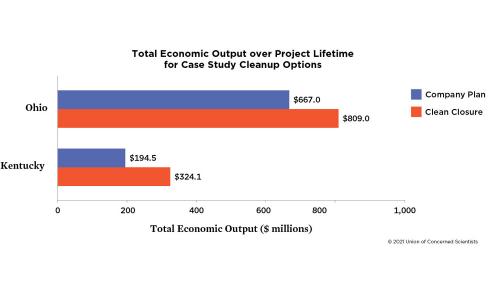
Repairing the damage economic output figure
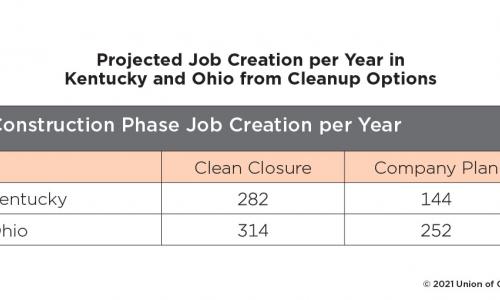
Repairing the damage projected job creation table
Downloads
Citation
Richardson, Jeremy, Ted Boettner, and Eric Dixon. 2021. Repairing the Damage: Cleaning Up Hazardous Coal Ash Can Create Jobs and Improve the Environment. Cambridge, MA: Union of Concerned Scientists and Ohio River Valley Institute.
Related resources

UCS vs Anti-Science Actions

UCS: What We Do

Understanding California’s Transmission Development Delays and Paths to Reform