Table of contents
Introduction
Public participation is core to a healthy democracy. Effective, meaningful engagement in government decisionmaking requires that community participation be treated not as a checkbox exercise, but as a long-term effort to build trust and respect between government decisionmakers and the historically disenfranchised communities most affected by US policies and programs (Minovi 2025a). US policies are more effective at improving conditions for the public when people—especially those most harmed by the legacy of injustices and discriminatory policies—have access to, influence over, and standing in decisionmaking processes (Minovi 2024; Minovi 2025a; Senecah 2024).
Federal law requires government agencies to engage and solicit input from the public in making certain decisions (Garvey 2017). However, the Trump administration has aggressively stripped away the public's right to participate in decisions that affect their communities and families' health and well-being (Minovi 2025b). The Union of Concerned Scientists (UCS) has documented unprecedented efforts to cut the public out of the rulemaking process; the slashing of government staffing and programs, including programs related to environmental justice, climate change, and public health; legally dubious Clean Air Act (CAA) exemptions for hundreds of polluting facilities; and more than 600 attacks on science, including rules that sideline science, politicization of grants and funding, and elimination of federal science positions (Minovi and Choiniere 2025; Minovi et al. 2025; Minovi and Ellickson 2025; Barbati-Dajches et al. 2026).
The federal government's wholesale rejection of participatory governance affects everyone, with profound repercussions for the ability of state, local, and Tribal governments to keep communities safe.
Public Participation in the Air Permitting Process
One form of government decisionmaking for which the CAA requires public participation is air permitting, whereby stationary sources of pollution (e.g., power plants) must apply for and receive a permit for air pollution emissions before construction and operation. The law established several permitting programs and delegated authority to US state, local, and Tribal agencies (permitting authorities) to administer these programs.
One such program covers operating permits issued under Title V of the CAA, which are required for (often) large sources of air pollution. These permits consolidate applicable air quality requirements involving facilities (such as power plants, refineries, chemical plants, and solid waste incinerators) that emit pollutants above specific thresholds (US EPA 2024c).
The New Source Review permitting program applies a separate framework before certain new facilities are built or existing facilities are modified (US EPA 2025). While administered at the state and local levels, Title V and New Source Review permits are overseen by the US Environmental Protection Agency (EPA).
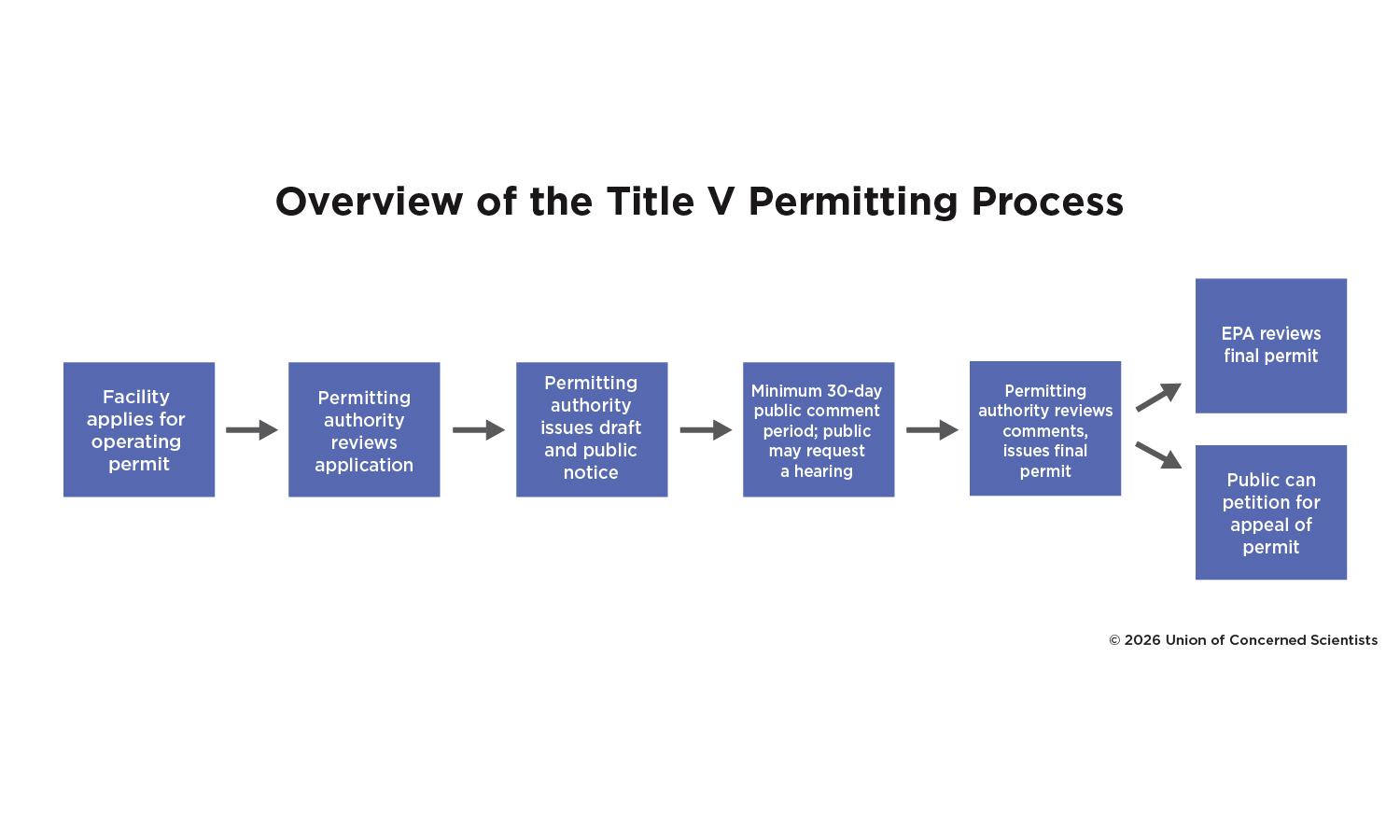
Title V requires opportunities for public input during the drafting of operating permits (Figure 1). After a state or local permitting authority (e.g., environmental agency) receives a Title V permit application from a facility operator/owner, it is required to 1) offer a 30-day public comment period and an opportunity to request a hearing on the draft permit, 2) maintain a record of significant comments, and 3) respond to significant comments in the final permit decision. The EPA must also guarantee that the public has an opportunity to petition the agency regarding a permit decision (i.e., challenge a permit that was approved) (US EPA 2026).
The New Source Review permitting process is not subject to the same public participation requirements as Title V permits. To make matters worse, a recent EPA rule proposed by the Trump administration would eliminate the minimum public-notice-and-comment requirements that are typically required to obtain these new and modified permits (Harvard EELP 2026). The elimination of requirements would extend to applications for sources like data center electricity-generation facilities, landfills, and asphalt plants (Johnson 2026).
Title V of the CAA established minimal procedural obligations that permitting authorities must meet regarding public engagement in major source permitting, but state and local governments can and should do significantly more (Minovi 2025a). The EPA reports that many Title V permits "do not receive significant public comment," but information about the process is not often accessible or proactively shared with the public (Szabo 2026; Minovi 2025a). For example, a focus group analysis of Title V permit notices in Michigan revealed that members of the public perceived the documents as "intentionally biased [toward industry], unnecessarily technical, and without clear directions on how and why to participate" (Sampson et al. 2023).
Furthermore, numerous Title V petitions submitted by groups representing communities overburdened by pollution have called out state agencies for inadequate opportunities to meaningfully engage in the process and failure to follow up once a decision is made (Earthjustice et al. 2022; Earthjustice et al. 2024).
Now, at the federal level, even these bare-minimum requirements are being deprioritized and rolled back. In early 2026, the EPA issued guidance urging states to expedite Title V permit review, focusing on rapid approval of permits over thoughtful consideration of public comments (Szabo 2026).
Opportunities to Enhance Meaningful Engagement
Despite these setbacks, permitting authorities can and should enhance meaningful public engagement in Title V permitting and regulatory decisions more broadly. According to guidance issued by the EPA in 2024 (and no longer implemented by the Trump administration), "meaningful engagement provides opportunities for the public to participate in decisions and share community concerns about activities that may affect their environment. Decision makers should seek out and facilitate the involvement of those potentially affected" (US EPA 2024a; US EPA 2024b).
Effective, meaningful engagement not only builds trust but also helps to prevent harm to the health and well-being of the people most affected by agency decisions. In the context of Title V, public comments can help identify omitted or incorrect provisions, fine-tune monitoring requirements, call for stronger enforcement, and raise procedural issues.
This analysis evaluates whether state permitting authorities are adopting and implementing specific practices and procedures to meaningfully engage the public in Title V air permitting.[i] To assess each permitting authority, we developed a survey tool informed by peer-reviewed literature, guidance and best practices developed by federal and state agencies, and gray literature integrating expertise from environmental justice leaders and organizations (including the UCSpublication Fair Access: Guidance for Meaningful Public Participation in Government Decisionmaking) (Minovi 2025a). The survey covers three categories of questions: information access; agency rules, guidance, and practices; and agency capacity. Survey data were collected through a combination of desktop research and interviews with agency staff.
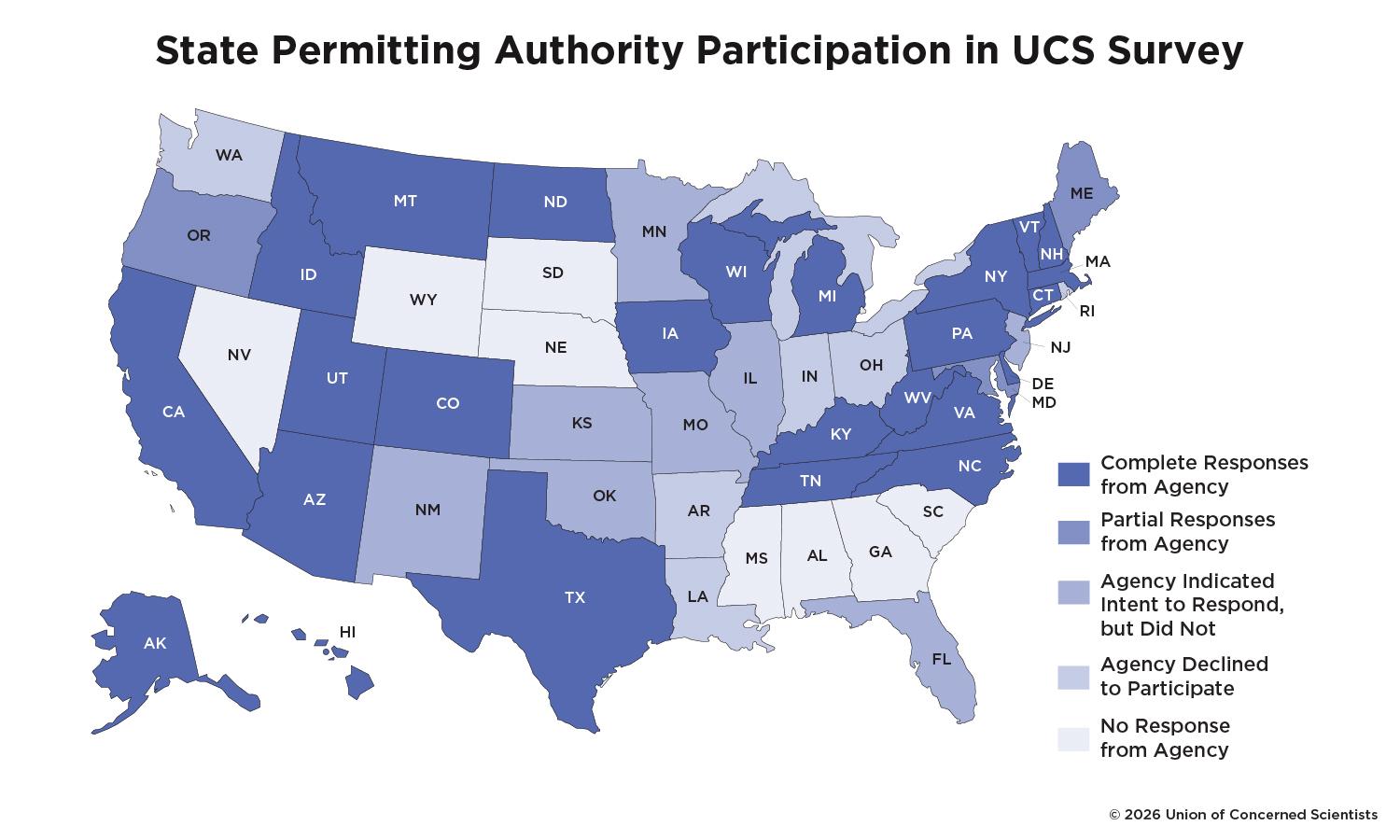
UCS received complete responses from 25 states and partial responses from three states; eight states indicated that they intended to provide responses but did not; six states declined to participate; eight states did not respond at all (see Figure 2). The complete methodology can be found on p. 13.
Findings
Information Access
Across the three categories, states performed best on their provision of information about draft Title V permits and opportunities for the public to comment (both required by the CAA). Nearly all permitting authorities provide information about approved and pending Title V permits on agency websites; however, this information is often scattered across different web pages and databases. Some agencies, such as Iowa's Department of Natural Resources, provide lists of draft and approved permits on one web page (Iowa DNR, n.d.).
On nearly all agency websites, however, a link to draft permits (often included on a public notice web page) is featured either on a Title V or air permitting web page or in the website menu or footer. The websites of at least half of all 50 states have a mapping feature or tool to help users see the locations of active Title V facilities.
While nearly all agencies post public notices for draft permits online, the amount and type of information varied greatly. Most states provide some combination of the draft permit number, the owner/operator name, the facility address, information on the public comment period, and a link or instructions to submit a public comment. Vermont's Department of Environmental Conservation and West Virginia's Department of Environmental Protection provide additional information about the decisionmaking status of draft permits and summary fact sheets, respectively (State of Vermont, n.d.; WVDEP, n.d.).
In most states, public hearings on Title V draft permits must be requested, and in general, public hearings happen infrequently. Information about public hearings, if one was held, was not often provided alongside details about the public comment period but placed on a separate web page altogether. However, Maryland's Department of the Environment provides an instructive example: Its information related to public comments, informational meetings, and public hearings is all contained on the agency's air permitting web page (MDE, n.d.).
Most states appear to provide accessibility services, such as language translation and interpretation services, for public hearings, although information about how to request these services is not always readily available (e.g., included in permit notices).
Review of Title V Draft Public Notices
A 2024 study of 20 states' Title V public notices found that they were "often written poorly and, on average, for readers with a college reading level" and failed to incorporate elements of plain language (Sampson et al. 2024). UCS reviewed up to three Title V public notices for 35 states (no qualifying online draft Title V permit notice could be located for 15 states during the study period) (see Figure 3). We assessed 87 public notices total.
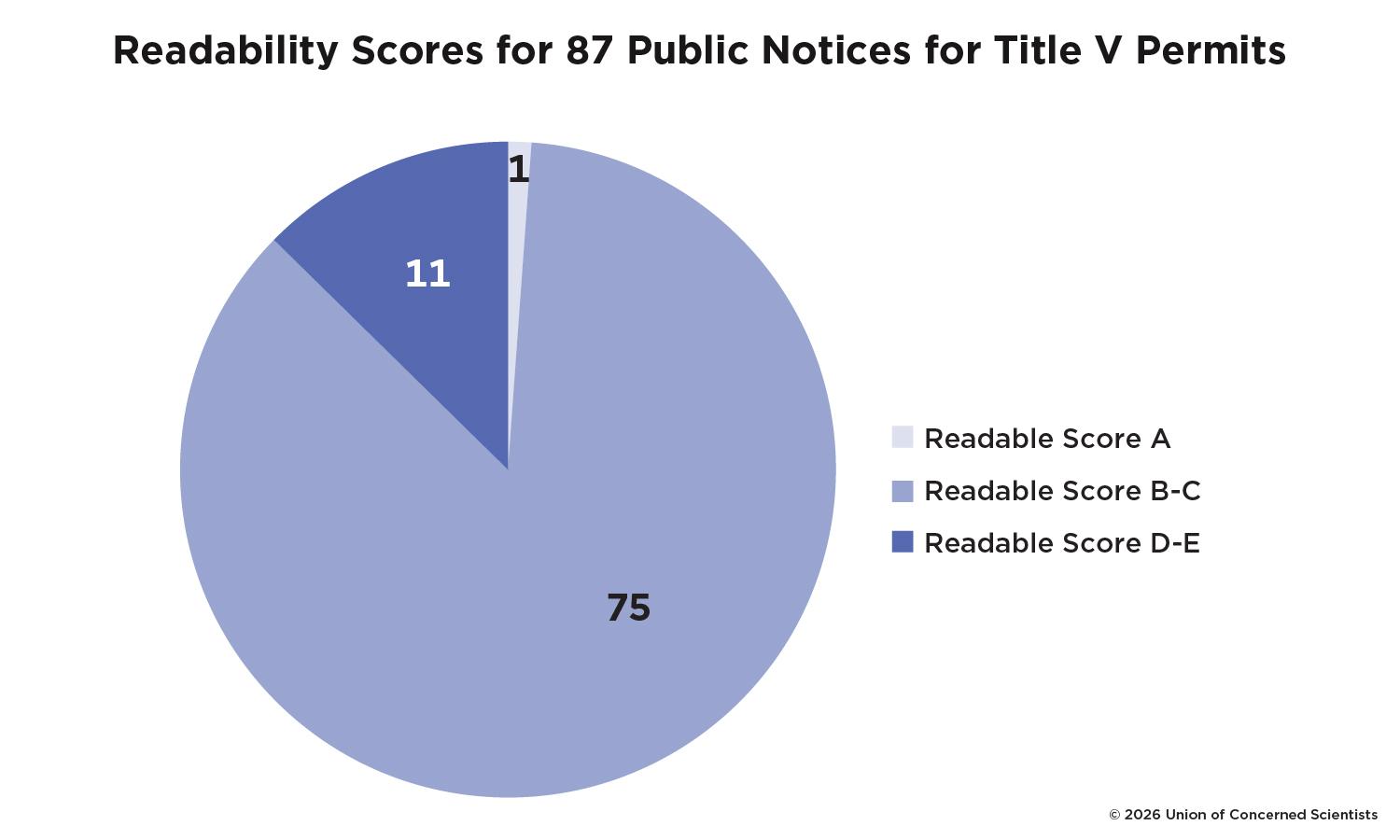
Using Readable,[ii] we found that 11 notices scored between a D and an E, 75 scored between a B and a C, and one scored an A. The notices that scored D--E were from Connecticut, Missouri, New Hampshire, New Jersey, and Texas. The single notice that received an A score was from Ohio's Environmental Protection Agency.
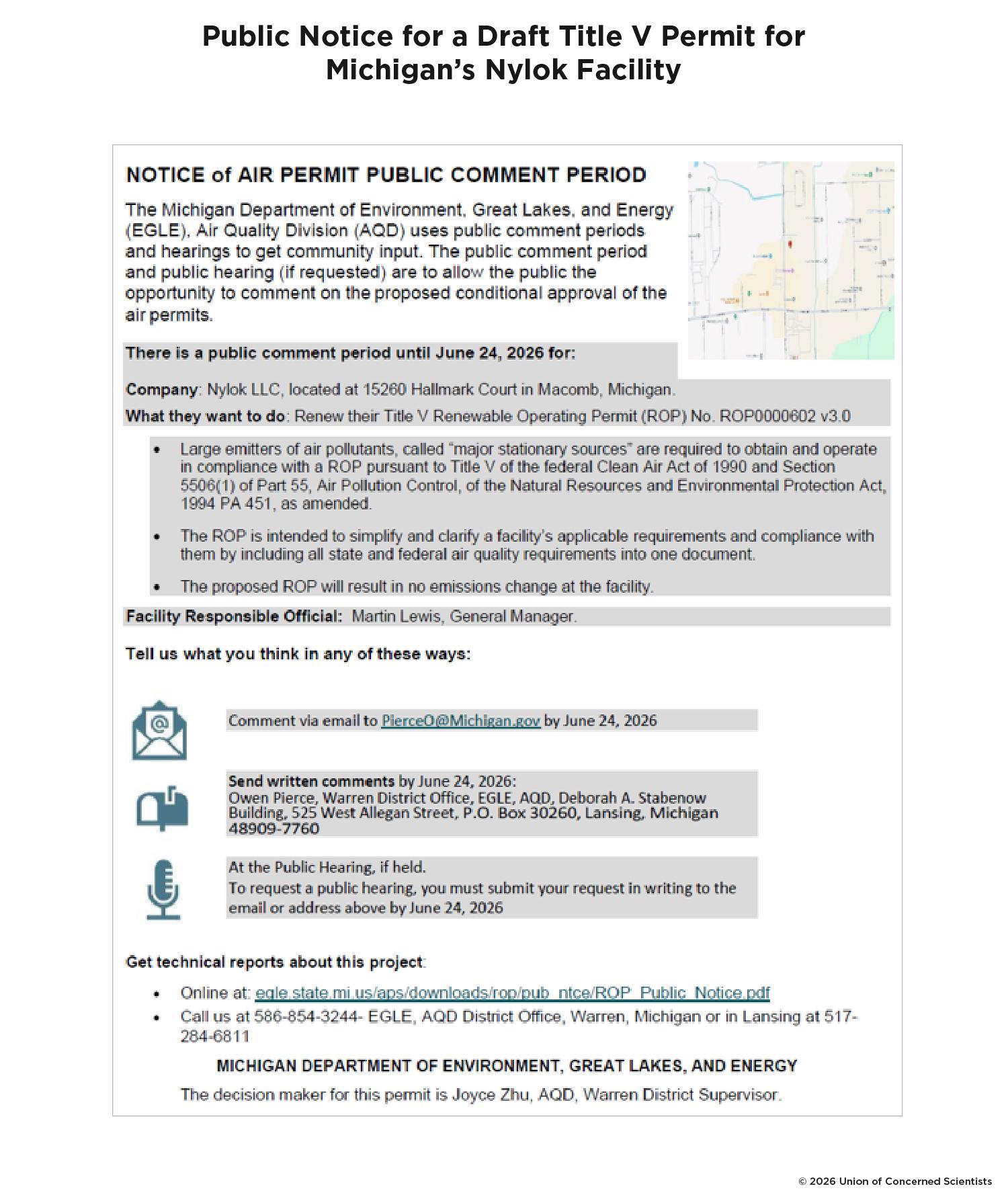
UCS also evaluated the degree to which agencies use elements of plain language in notices—for example, employing bullet points, short paragraphs, headers, and white space, and defining acronyms or scientific terms (Sampson et al. 2024). Minnesota and Michigan notices (see Figure 4) were the only ones to integrate three or more elements of plain language.
While nearly all states provide instructions for how to submit public comments in the notice itself, and most, at least briefly, describe how to request a public hearing, fewer than half of the reviewed notices (41 out of 87) provided a contact email and phone number for questions related to the draft permit and process. Furthermore, only six agencies (in Delaware, Illinois, Massachusetts, Michigan, North Carolina, and Texas) translated notices to other languages relevant to the state's population, such as Spanish and Haitian Creole.
Findability of Information on How to Participate
In addition to public notices, at least 42 agencies have a web page or online document describing how the public can participate in the permitting process, but among these, 16 describe only how to participate, not how public input will shape the process.
Among the 42 agencies, 23 have additional online resources to support engagement in the air permitting process. For example, Arizona's Department of Environmental Quality has a YouTube video describing the environmental permitting process, Minnesota's Pollution Control Agency has a web page and infographic describing how to make effective public comments, and North Dakota's Department of Environmental Quality provides examples of "common comment mistakes" (AZDEQ 2024; MPCA, n.d.; North Dakota DEQ, n.d.). Connecticut's Department of Energy and Environmental Protection provides a particularly instructive example, hosting one web page with resources related to the permitting process, including information on how applicants can engage the surrounding community and guidance for public hearings (Connecticut DEEP, n.d.).
Overall, however, UCS found that online information on how to participate in the air permitting process was hard to find. Agencies that provided an explicit "public participation" (or related term) link on their website's menu bar or had such a page linked from their air permitting web page were easiest to navigate. Wisconsin's Department of Natural Resources and New Mexico's Environment Department provide helpful examples of how information on how to participate can be clearly integrated into an agency's air permits web page or website menu bar, respectively (Wisconsin DNR, n.d.; NMED, n.d.).
Findability of Information on How Participation Shapes the Process
To promote meaningful engagement, agencies should not only accept comments but also report on how input shaped the process (Minovi 2025a). Of the 28 agencies that sent us complete or partial responses, 18 indicated that they publicly post online responses to public comments on draft permits. Among those, only 13 could provide an example of when public input led to at least one change to a final permit.[iii]
Among the 25 agencies that sent UCS complete responses, nine indicated that they do not post responses to comments publicly. While some stated that responses are sent directly to those who comment on permits or are available upon request, our findings indicate that, despite providing an opportunity for the public to comment on draft permits, states do not widely disclose how public comments inform final permit decisions.
Several agencies stated that they do not get many public comments on draft Title V permits. However, it appears that even if they do, the public does not have a great deal of influence on the outcome. South Carolina's Department of Environmental Services provides an instructive example of how such information can be made explicitly available. The department's "Air Quality Department Decisions" web page includes its decision, responses to comments, the final permit, a letter to the public, and contact information for further questions (SCDES, n.d.).
Agency Rules, Guidance, and Practices
Participation Laws and Screening Tools
Some states have gone beyond just making information available, implementing policies and guidance to enhance meaningful public engagement. At least 11 states have laws that enhance public participation in air permitting, some of which are cumulative impacts laws that require additional screening/analysis and engagement in permitting decisions (Ellickson and Curtis 2024). In general, states with such laws appeared to have more publicly available resources and information on how to engage in the air permitting process.
At least 16 states also have internal guidance for agency staff related to enhancing meaningful engagement. Half of these states have the aforementioned engagement laws. For example, the Pennsylvania Department of Environmental Protection's environmental justice policy, finalized in early 2026, describes explicit strategies for enhanced outreach to communities during the permitting process, including the use of PennEnviroScreen to identify "environmental justice areas" (Pennsylvania DEP, n.d.).
At least nine states use health, socioeconomic, and/or pollution burden data, such as the data found in an environmental justice screening tool, in Title V permit reviews. Five of these states have the aforementioned engagement laws. Two additional states privately disclosed that they were actively using or exploring the use of the EPA's EJSCREEN tool in regulatory decisions, but they no longer are because the Trump administration removed the tool from public use in 2025 (Woods 2025).
Advisory Board and Committee Participation
UCS also evaluated the degree to which states provide opportunities for the public to participate in permit decisions through advisory boards and committees (Minovi 2025a). While numerous states have air quality boards and other advisory bodies that provide guidance on agency regulations and policy, few have decisionmaking authority in air permitting, and fewer still require members who represent the public interest.
Of the 28 states that sent UCS complete or partial responses, nine have a board or committee that has some degree of authority or influence in Title V permitting decisions. Many of these boards, however, have authority only over appeals or challenged permits. Furthermore, only six of these nine states require the board or committee to include members who represent the public interest rather than a specific field or industry.
For example, Maine's Board of Environmental Protection is a seven-member "citizen board" with participants nominated by the governor. It "performs major substantive rulemaking, makes decisions on select permit applications and appeals of Commissioner licensing and enforcement actions, and provides a forum for public participation in department decisions" (Maine DEP, n.d.).[iv]
Agency Practices
At least 20 agencies facilitate or participate in in-person or virtual activities outside of a public hearing, and these activities may guide decisionmaking on permitting. Such activities include town halls, agency staff attendance at community meetings, and educational trainings. For example, New Jersey's Department of Environmental Protection hosts seminars that are targeted to environmental justice advocates and describe how to engage in regulatory processes (NJDEP, n.d.).
In contrast, among the 28 states UCS received complete or partial responses from, seven indicated that they do not participate in these types of activities. All seven of those states do not have the aforementioned engagement laws. Altogether, these findings suggest that states with relevant public engagement statutes (such as environmental justice or cumulative impacts laws, which include provisions to enhance meaningful engagement) may be more likely to have policies and activities to support public engagement.
Finally, to better understand agency priorities, we assessed whether agency "About" or "Mission and Values" web pages mention "public participation" or related terms. Fewer than half (21) of all agencies use language related to meaningful engagement, public input, or lived experience on their "About" web pages. New York's Department of Environmental Conservation had one of the most explicit expressions of these values, stating that the agency sought to achieve its mission "through the simultaneous pursuit of environmental quality, public health, economic prosperity and social well-being, including environmental justice and the empowerment of individuals to participate in environmental decisions that affect their lives" (NYSDEC, n.d.).
Agency Capacity
UCS also evaluated the degree to which agencies have the capacity to enhance public engagement in the air permitting process. Since this issue pertains to internal agency matters, responses could be evaluated only for agencies that responded to the survey.
Among the 28 agencies that sent UCS complete or partial responses, 20 indicated that they provide explicit training to staff on topics related to community engagement, environmental justice, public participation, and/or risk communication.
Only 16 of the 28 agencies stated that they have at least one full-time employee dedicated to enhancing public participation, including for areas such as permitting. For many states, these functions were fulfilled by staff in an office of environmental justice and/or community engagement. Several of the agencies that did not have these roles stated that these functions were part of administrative, permitting, and other staff duties, but not a distinct job.
Only three of the 28 agencies indicated that they provide some form of financial assistance, such as grants, that could be used to help community organizations participate in permitting processes or other agency decisionmaking. However, the future of these programs remains unclear following sweeping federal cuts to EPA grantmaking (Slattery 2025).
While general staffing levels, agency budget, state legislative priorities, and other factors can influence agency capacity, it appears that overall, state agencies have limited internal capacity to enhance meaningful engagement in permitting beyond the existing training provided to staff.
States Can Do More to Meaningfully Engage the Public in Air Permitting Processes
While Title V air permitting is only one part of a wide array of regulatory processes that state, local, and Tribal agencies implement, this study reveals that major gaps and barriers prevent permitting authorities from effectively and meaningfully engaging the public in decisionmaking. Although there are numerous instructive examples from many states, progress is inconsistent and may not result in affected communities feeling that their input matters.
In addition, state agencies face funding shortfalls, bureaucratic hurdles, and political pressure from state lawmakers and the federal government (Clawson et al. 2026; Kelderman et al. 2025). In this current political climate, many states face threats from the Trump administration for work that advances environmental justice and meaningful engagement (White House 2025; Taft 2026). Finally, permitting authorities must also balance their obligations to permit applicants, who may be technically complying with the law.
Ultimately, the fact that 22 states were unresponsive, unwilling, or unable to participate in the UCS survey is in and of itself indicative of the challenge to increase the public's access to government officials, as well as the challenges of limited staff capacity and policies that may hinder public engagement.
Meaningful engagement requires investment at all levels, from elected officials (such as governors and their priorities) to agency leadership (and the culture they establish). Furthermore, public engagement requires time, funding, and a commitment to building trust with the people who state agencies serve. Permitting authorities, especially at the state level, can and should do more to expand opportunities for the public to engage in air permitting processes, to clearly communicate how the public can influence decisions, and to transparently report how those decisions were shaped by public input.
Recommendations
At a bare minimum, agencies must provide the public with legally compliant notice and comment opportunities. To enhance meaningful engagement in air permitting processes and regulatory decisions more broadly, state and local authorities could do the following:
-
Ensure the agency has a distinct public participation web page or resources, either on its air permitting web pages or website menu bar. These pages should include multilingual information describing what opportunities there are to participate in regulatory decisions, how to do so, how input influences agency decisionmaking, and how agency decisions were shaped by public input.
-
Publish responses to comments online, ideally in a clearly named document (such as "Responses to Comments"), and ensure responses are also shared directly with anyone who submitted written and oral comments.
-
Use elements of plain language in public notices, including headers, bullets, white space, and definitions of scientific concepts and acronyms (Sampson et al. 2024). Notices should also include a staff contact's phone number and email address for questions related to a permit, instructions on how to submit a comment, explicit descriptions of how to request a public hearing, and deadlines for participation (which should be given as dates instead of statements like "30 days in the future"). Agencies should proactively translate notices to languages appropriate to the affected communities.
-
Require the implementation of agency guidance or plans to enhance meaningful public engagement in permitting and ensure that staff can attend relevant trainings.
-
Assess proactively whether public engagement activities are effective, including whether individuals in the affected communities found notices to be understandable, whether public comments identified permit errors or other issues, and whether participants received follow-up information.
Furthermore, governors and/or agency leadership could do the following:
-
Issue executive orders implementing policies and practices to enhance meaningful engagement, where existing authority allows.
-
Establish agency-wide language related to meaningful engagement and disability access standards.
-
Direct agencies to develop public participation or meaningful engagement plans.
Finally, state lawmakers could introduce and/or support legislation enhancing meaningful engagement in agency decisionmaking, including decisions on permitting. Such legislation may focus on advancing cumulative impacts policies, environmental justice, and/or appropriations and could do the following:
-
Require enhanced engagement, additional information on impacts, and extended public comment opportunities in areas with higher health, socioeconomic, and pollution burdens where proposed or renewed Title V facilities are located (as identified through screening tools or cumulative impacts analyses).
-
Establish a permitting board or advisory committees that 1) must have diverse members who represent the public interest and 2) have decisionmaking authority or influence in Title V decisions, for example, reviewing challenged permits.
-
Create grant programs to support community organizations in hiring technical consultants or additional support to more effectively engage in permitting processes.
-
Require agencies to establish internal guidance for enhancing meaningful engagement in decisionmaking, with a plan for proactive and continuous engagement with potentially impacted parties (including community meetings and other opportunities to receive input outside of public hearings) and a plan for enhancing language and disability access.
-
Fund additional staffing and training dedicated to community engagement and language access.
-
Fund translation, interpretation, accessible technology, and outreach to enhance disability access.
-
Require transparent reporting on the use of such funds and the outcomes of that use.
For additional recommendations on enhancing meaningful engagement, see Fair Access: Guidance for Meaningful Public Participation in Government Decisionmaking (Minovi 2025a).
Methodology
UCS developed the survey tool using Fair Access: Guidance for Meaningful Public Participation in Government Decisionmaking (henceforth Fair Access Guidance), which was supplemented by a literature review of articles from PubMed and Google Scholar. The literature review was completed in February 2026 and focused on engagement in Title V permitting. The survey sections ("Information Access"; "Agency Rules, Guidance, and Practices"; and "Agency Capacity") were informed by Fair Access Guidance, and the review yielded 23 relevant publications.
The draft survey was reviewed by four experts and featured 88 questions (binary, multiple choice, and write-in). It was uploaded to Microsoft Forms.
The author administered the survey, collecting data from all 50 states (not including Puerto Rico or other US territories) between April 13, 2026, and August 26, 2026. Since Title V programs may be administered by multiple state, local, regional, or Tribal authorities, responses from any single authority do not necessarily represent all permitting practices within a state.
The unit of analysis was the principal state-level Title V permitting authority in 49 states. California's Title V program is administered primarily through regional air districts. South Coast Air Quality Management District was selected because it serves the state's largest population. Accordingly, California findings should not be interpreted as representative of all California air districts.
For each state, the author completed a new survey form, first using desktop research to answer as many questions as possible in the "Information Access" and "Agency Rules, Guidance, and Practices" sections. Some questions were marked "unsure" and all the questions in the "Agency Capacity" section were left blank.
After this, the author emailed an air permitting division official in the relevant agency, requesting to share the remaining questions via email or a virtual meeting. The author periodically followed up with agencies that had not responded, emailing other officials in the agency and/or calling the agency directly.
As shown in Figure 2, during the study period, UCS received complete responses from 25 states and partial responses from three states; eight states indicated that they intended to provide responses but did not; six states declined to participate; and eight states did not respond at all. Of the agencies that provided complete or partial responses, 25 responded via email, and three provided responses via virtual meeting. The author transcribed virtual meeting responses in real time. The author updated forms for each state upon receipt of responses.
Limitations and Uncertainties
There are several limitations to the analysis. Information available on agency websites is often disjointed or available in multiple places. While the author sought to overcome this by contacting agency staff if a question could not be answered, it is possible that we were not able to uncover all the resources that states make available to the public. We addressed this by contextualizing our findings with the phrase "at least [X number] of states/agencies," to indicate that there may be more.
In addition, the survey was administered by one researcher, rather than multiple coders, which may affect reliability. Furthermore, surveys were completed for each state in alphabetical order. Therefore, the states earlier in the alphabet had more time to return responses than those for which the form was completed later in the study period.
Capacity constraints also affected some agencies' ability to respond. For example, the Oregon Department of Environmental Quality provided a partial response because many of its staff had been deployed for a wildfire response.
Our analysis does not include community members' perspectives on the degree to which they experience engagement with agencies and relies on government agency definitions of "meaningful engagement," which may not necessarily reflect the engagement needs and barriers faced by different communities across the US. While 13 responding agencies provided an example in which input resulted in a documented permit change, the absence of such an example does not necessarily establish that public input had no other effect.
Finally, most findings are based on 28 complete or partial responses and may overrepresent agencies with greater engagement capacity.
Authors
Darya Minovi is manager of fair access research for the Center for Science and Democracy at UCS.
Acknowledgments
This analysis was made possible by the generous support of Democracy Fund, the Bernard F. and Alva B. Gimbel Foundation, the Weissman Family Foundation, Orchard Foundation, and UCS members.
The author would like to thank Kristie Ellickson, Alexa Dietrich, Kristin Hook, Natalie Sampson, Brooke Helmick, and Gretchen Gehrke for their technical review and Christina Stone, Eric Schulz, Lana Cohen, Cynthia Williams, Heather Tuttle, Bryan Wadsworth, Omari Spears, Cynthia DeRocco, and Meisei Gonzalez for their editorial and publication expertise.
The opinions expressed herein do not necessarily reflect those of the organizations that funded the work or the individuals who reviewed it. The Union of Concerned Scientists bears sole responsibility for the report's content.
Notes
[i]1. UCS surveyed state agency websites and staff for all states but California. Since Title V permitting in California is primarily handled by regional air authorities, we surveyed the regional air authority that serves the largest population in the state: the South Coast Air Quality Management District. For the purposes of this analysis, however, we refer to our findings for all "states."
[ii]2. Readable is a language tool that integrates readability formulas (such as the Flesch-Kincaid Grade Level) to produce a letter grade much like on a school report card (Readable, n.d.).
[iii]3. While we did not receive responses from agency staff in Georgia and South Carolina, for both states, we were able to find examples of public comments leading to at least one change in final permit language.
[iv]4. Correspondence with Maine Department of Environmental Protection official.
References
AZDEQ (Arizona Department of Environmental Quality). 2024. "Environmental Permitting 101." YouTube, 2 min., 26 seconds. August 19, 2024. https://www.youtube.com/watch?v=UrllRnWUs54
Barbati-Dajches, Jules, Kristie Ellickson, Erick Velez, and Alexa Dietrich. 2026. "Attacks on Science." Union of Concerned Scientists. https://www.ucs.org/resources/attacks-on-science
Clawson, James, Ursula Kaczmarek, Noam Ross, Eric R. Scott, Mally Shan, Emma Mairson, and Scott Delaney. 2026. Lost Funds: A States United and Grant Witness Project Tracking Funding Disruptions under the Trump Administration [Dataset]. Accessed September 21, 2026. https://lostfunds.org
Connecticut DEEP (Department of Energy and Environmental Protection). n.d. "Participate in the Permitting/Policy Process." Accessed August 27, 2026. https://portal.ct.gov/deep/environmental-justice/04-participate-in-the-permitting-policy-process
Earthjustice, Caring for Pasadena Communities, Texas Environmental Justice Advocacy Services, Sierra Club (Lone Star Chapter), and Environmental Integrity Project. 2024. Petition to Object to the Title V Operating Permit for the Valero Houston Refinery. Submitted to the Administrator, US Environmental Protection Agency. August 19. https://earthjustice.org/wp-content/uploads/2024/08/valero-houston-final-title-v-petition-2024.-08.-19.pdf
Earthjustice, Environmental Integrity Project, Delaware Audubon Society, Delaware Concerned Residents for Environmental Justice, Environmental Justice Health Alliance for Chemical Policy Reform, Sierra Club, and the Widener Environmental and Natural Resources Law Clinic. 2022. Petition to Object to the Title V Operating Permit for the Delaware City Refinery. Submitted to the Administrator, US Environmental Protection Agency. September 16. https://www.epa.gov/system/files/documents/2022-09/Delaware%20City%20Refinery%20Petition_9-16-22.pdf
Ellickson, Kristie, and Kathleen A. Curtis. 2024. The Community Guide to Cumulative Impacts: Using Science and Organizing to Advance Public Health Policy. Cambridge, MA: Union of Concerned Scientists. https://www.ucs.org/resources/community-guide-cumulative-impacts
Garvey, Todd. 2017. A Brief Overview of Rulemaking and Judicial Review. CRS Report R41546. Washington, DC: Congressional Research Service. https://www.congress.gov/crs-product/R41546
Harvard EELP (Environmental & Energy Law Program). 2026. "New Source Review." https://eelp.law.harvard.edu/tracker/new-source-review/
Iowa DNR (Department of Natural Resources). n.d. "Draft & Final Permits." Accessed August 27, 2026. https://www.iowadnr.gov/environmental-protection/air-quality/operating-permits/draft-final-permits
Johnson, Clark. 2026. "EPA Proposes Ending Mandatory Public Comment on Minor-Source Data Center Permits." Tech Times. August 26. https://www.techtimes.com/articles/325694/20260826/epa-proposes-ending-mandatory-public-comment-minor-source-data-center-permits.htm
Kelderman, Keene, Tom Pelton, Louisa Markow, Ari Phillips, Brendan Gibbons, and Paul MacGillis-Falcon. 2025. State of Decline: Cuts to State Pollution Control Agencies Compound Damage from the Dismantling of EPA. Washington, DC: Environmental Integrity Project. https://environmentalintegrity.org/wp-content/uploads/2025/12/EIP_Report_StateofDecline_12.10.25.pdf
Maine DEP (Department of Environmental Protection). n.d. "State of Maine Board of Environmental Protection." Accessed August 27, 2026. https://www.maine.gov/dep/bep/index.html
MDE (Maryland Department of the Environment). n.d. "Air and Radiation Permits, Licenses and Approvals." Accessed August 27, 2026. https://mde.maryland.gov/programs/Permits/AirManagementPermits/Pages/index.aspx
Michigan Department of Environment, Great Lakes, and Energy. 2026. "Nylok LLC." Accessed June 9, 2026. https://mienviro.michigan.gov/ncore/external/publicnotice/info/7171498919466496907/documents
Minovi, Darya. 2024. "For Real Environmental Justice, We Need Community Input into Federal Rules." The Equation (blog). January 24. https://blog.ucs.org/dminovi/for-real-environmental-justice-we-need-community-input-into-federal-rules/
---------. 2025a. Fair Access: Guidance for Meaningful Public Participation in Government Decisionmaking. Cambridge, MA: Union of Concerned Scientists. https://www.ucs.org/resources/fair-access
---------. 2025b. "President Trump Is Shutting Out the US Public from Government Decisions." The Equation (blog). September 9. https://blog.ucs.org/dminovi/president-trump-is-shutting-out-the-us-public-from-government-decisions/
Minovi, Darya, Jules Barbati-Dajches, Rachel Cleetus, and Kristie Ellickson. 2025. Science and Democracy Under Siege: Documenting Six Months of the Trump Administration's Destructive Actions. Cambridge, MA: Union of Concerned Scientists. https://www.ucs.org/resources/science-and-democracy-under-siege
Minovi, Darya, and Alexander Choiniere. 2025. Access Denied: How the Trump Administration Is Eliminating Public Input. Cambridge, MA: Union of Concerned Scientists. https://www.ucs.org/resources/access-deniedv
Minovi, Darya, and Kristie Ellickson. 2025. Dirty Air, Dirty Deeds: Trump Administration Shuts Out Public Input, Increases Toxic Air Pollution. Cambridge, MA: Union of Concerned Scientists. https://www.ucs.org/resources/dirty-air-dirty-deeds
MPCA (Minnesota Pollution Control Agency). n.d. Effective Public Comments: How to Make Your Voice Heard. Saint Paul, MN. Accessed August 27, 2026. https://www.pca.state.mn.us/sites/default/files/MPCA-effective-public-comments.pdf
NJDEP (New Jersey Department of Environmental Protection). n.d. "Environmental Justice: Attend a Training." Accessed August 27, 2026. https://dep.nj.gov/ej/seminars/
NMED (New Mexico Environment Department). n.d. Home page. Accessed August 27, 2026. https://www.env.nm.gov/
North Dakota DEQ (Department of Environmental Quality). n.d. "Public Comment Tips." Accessed August 28, 2026. https://deq.nd.gov/PublicCommentTips.aspx
NYSDEC (New York State Department of Environmental Conservation). n.d. "About DEC." Accessed August 27, 2026. https://dec.ny.gov/about
Pennsylvania DEP (Department of Environmental Protection). n.d. "Environmental Justice Policy." Accessed August 27, 2026. https://www.pa.gov/agencies/dep/public-participation/office-of-environmental-justice/ej-policy
Readable. n.d. "Readability Formulas." Accessed August 27, 2026. https://readable.com/readability/readability-formulas/
Sampson, Natalie, Carmel Price, Melanie Sampson, Mary Bradshaw, and Bianca Freeman. 2024. "Lessons from a Plain Language Analysis: U.S. Clean Air Act Title V Public Notices as Barriers to Environmental Justice." Environmental Science & Policy 151: 103604. https://doi.org/10.1016/j.envsci.2023.103604
Sampson, Natalie, Melanie Sampson, Carmel E. Price, Sara Almuktar, Andrew Bashi, and Samra'a Luqman. 2023. "Plain Language as a Prerequisite for Environmental Justice." Environmental Justice 16 (2): 126--39. https://doi.org/10.1089/env.2021.0108
SCDES (South Carolina Department of Environmental Services). n.d. "Air Quality Department Decisions." Accessed August 27, 2026. https://www.des.sc.gov/programs/bureau-air-quality/air-quality-department-decisions
Senecah, Susan L. 2024. "The Trinity of Voice: A Framework to Improve Trust and Ground Decision Making in Participatory Processes." Journal of Environmental Planning and Management 67 (9): 2091--2115. https://doi.org/10.1080/09640568.2023.2238126
Slattery, Meg. 2025. "Trump's EPA Cancelled 350 Environmental Justice Grants, Then Congress Cut Funding for Future Projects. Here's Why That Matters." Earthjustice, July 11. https://earthjustice.org/article/trumps-epa-cancelled-350-environmental-justice-grants-then-congress-cut-funding-for-future-projects-heres-why-that-matters
State of Vermont. n.d. "Environmental Notice Bulletin." Accessed August 27, 2026. https://enb.vermont.gov/
Szabo, Aaron. 2026. "Guidance on Streamlining Title V Operating Permit Reviews." Memorandum to Regional Administrators, Regions 1--10, May 11. Washington, DC: US Environmental Protection Agency. https://www.epa.gov/system/files/documents/2026-05/guidance-on-streamlining-title-v-operating-permit-reviews-5-11-26.pdf
Taft, Molly. 2026. "The Trump Administration Wants to Change Public Engagement Rules for Polluters." Wired, July 23. https://www.wired.com/story/trump-administration-change-polluter-public-engagement-rules/
US EPA (United States Environmental Protection Agency). 2024a. Achieving Health and Environmental Protection Through EPA's Meaningful Engagement Policy. Washington, DC. https://www.epa.gov/system/files/documents/2024-09/achieving-health-and-environmental-protection-through-epas-meaningful-engagement-policy-august-2024.pdf
---------. 2024b. "How Meaningful Engagement and Community-Driven Solutions Can Improve Your Climate Adaptation and Resilience Projects." Infographic. https://www.epa.gov/system/files/documents/2024-07/epa-meaningful-engagement_infographic.pdf
---------. 2024c. "Who Has to Obtain a Title V Permit?" https://www.epa.gov/title-v-operating-permits/who-has-obtain-title-v-permit
---------. 2025. "Learn About New Source Review." https://www.epa.gov/nsr/learn-about-new-source-review
---------. 2026. "Title 40: Part 70—State Operating Permit Programs." https://www.ecfr.gov/current/title-40/chapter-I/subchapter-C/part-70
White House. 2025. "Executive Order 14260: Protecting American Energy Against State Overreach." Accessed September 21, 2026. https://www.whitehouse.gov/presidential-actions/2025/04/protecting-american-energy-from-state-overreach/
Wisconsin DNR (Department of Natural Resources). n.d. "Air Permits and Regulations." Accessed August 27, 2026. https://dnr.wisconsin.gov/topic/AirPermits
Woods, Stacy. 2025. "The Trump Administration's Deletion of Environmental Justice Data Does Real Harm." The Equation (blog). February 27. https://blog.ucs.org/stacy-woods/the-trump-administrations-deletion-of-environmental-justice-data-does-real-harm/
WVDEP (West Virginia Department of Environmental Protection). n.d. "Title V Permits and Applications." Accessed August 27, 2026. https://dep.wv.gov/daq/permitting/titlevpermits/Pages/default.aspx