Table of contents
This is a condensed, online version of the fact sheet. For all figures, references, and the full text, please download the full fact sheet.
California Is Already Home to Many Large Data Centers
California has housed many data centers for decades, particularly in the San Francisco Bay Area and Los Angeles. However, information on the number of existing and projected data centers is difficult to gather because there is no clear definition of what qualifies as a "data center" and data center owners are rarely forthcoming about their development. Estimates suggest California has a few hundred data centers, and the vast majority of these are smaller facilities requiring less than 50 megawatts (MW) of electricity (Data Center Map 2026).
One way to track the number of larger data centers (those requiring over 50 MW) is to examine California Energy Commission (CEC) regulatory applications for large backup generation facilities at data centers. Almost all large data centers have backup generators (often diesel fired), and the CEC licenses all thermal power plants over 50 MW. Plants categorized as less than 100 MW can be exempted from licensing through the CEC's Small Power Plant Exemption. The offer of this exemption partly explains why all existing California data centers use less than 100 MW. Nineteen data centers using between 50 MW and 100 MW have applied to the CEC for backup generation projects (Figure 1). These data centers have an average peak electricity demand of 92 MW; 15 projects have already been approved (CEC 2026).
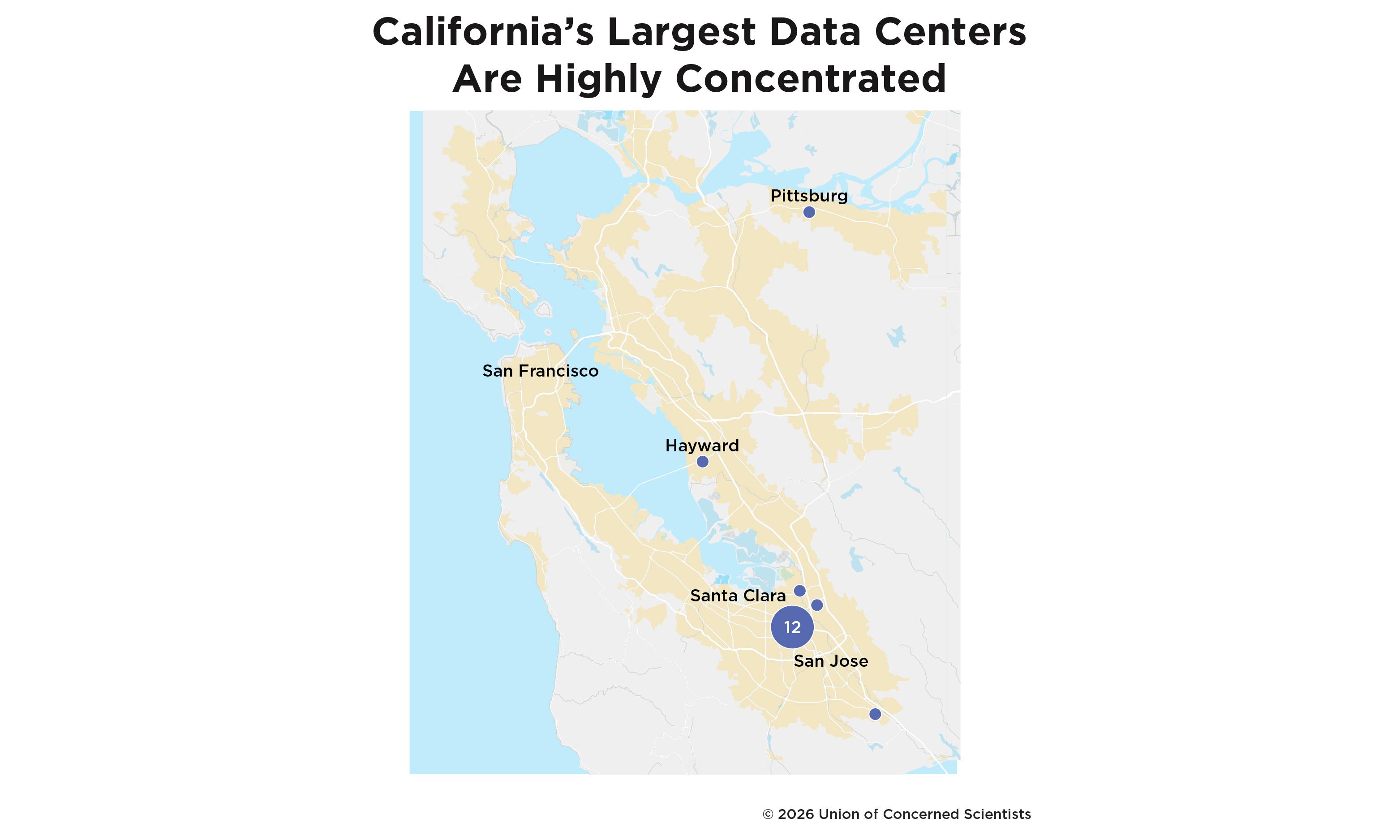
Notes: The two large data centers located outside of the San Francisco Bay Area are planned for Vernon and Inyokern. While there may be other large data centers in California without thermal backup generation over 50 MW, this is unlikely, as large data centers typically have on-site thermal backup generation to achieve the industry standard of 99.999 percent uptime. Although companies plan to base many additional large data centers in California, they have not yet applied for CEC licenses for thermal backup generation.
Source: CEC 2026.
California Projects High Electricity Demand Growth Because of New Data Centers
The 2022 expansion of generative artificial intelligence (AI) models massively increased the demand for data centers and the electricity that powers them. California is expected to have an influx of new data centers over the next decade, including much larger facilities than the state has previously seen. However, most new projects still require 100 MW at the most. In 2025, the CEC documented 103 data center agreements and applications, with almost 90 percent of these categorized as needing 100 MW or less (Cooper 2025).
Data centers are highly energy-intensive and are expected to add significant new load to the grid. The CEC estimates data centers will bring an additional two gigawatts (GW) of electricity load to the state by 2030 and 4 GW by 2040 (Cooper 2025). However, there is significant uncertainty about how much load from data centers will materialize. On the one hand, Pacific Gas & Electric Company (PG&E), the largest California utility, has received applications for 10 GW of data center load (Cooper 2025). On the other hand, evidence exists that new data center load may be overestimated because of developers submitting speculative project requests, project delays from grid constraints, and general uncertainty about the AI industry (Quint et al. 2025).
Data Centers Could Set Back the Clean Energy Transition and Grid Reliability
While California data center load projections are lower than those for states like Virginia and Texas, this additional electricity demand is still significant and could notably affect the power grid (Clemmer et al. 2026). Foremost, California would need to build large amounts of electricity-generating resources to accommodate the projected demand increase. Major delays already exist in the time it takes to bring new clean energy online, so this rapid rise in demand will put additional pressure on the clean energy transition. California's clean energy and global warming emissions reduction mandates provide some guardrails, but clean energy progress could slow down as gas plants run more frequently to meet data center electricity demand, or as new clean energy is directed to data centers rather than grid decarbonization.
Second, the increase in data centers will result in a similar increase in backup generators, which have historically largely been diesel fired. These generators are rarely called upon to provide backup power, but their emissions, including from routine testing and maintenance, can contribute heavily to local air pollution, with harmful consequences to air quality and the health of nearby residents (Liu, Wu, and Ren 2025). These impacts are amplified by the geographic concentration of data centers near dense population centers (Figure 1) (Data Center Map 2026). With more data centers coming online, minimizing the use of fossil-fueled backup generators is essential to protecting air quality and public health.
Third, data centers present new challenges to the grid, such as risks to reliability. The facilities are highly sensitive to voltage and frequency fluctuations on the grid, which can lead to sudden disconnections. Additionally, AI-training data centers rapidly increase and decrease power use in unpredictable ways (Quint et al. 2025). Both of these behaviors can be difficult for grid operators to manage, and the risk of these issues leading to broader reliability events increases as data centers proliferate. California's grid operator is studying the extent to which these issues could affect the grid and how to address these risks (CAISO 2026b).
There Is a Clear Risk That Data Centers Will Increase Ratepayer Costs
The build-out of data centers could increase electricity system costs in multiple ways. If all those costs are sufficiently paid for by the companies that own the data centers, Californians could theoretically experience downward pressure on electricity costs. However, the state currently has too few protections to ensure data center costs are not passed along to ratepayers.
Data centers can drive up electricity system costs in three main ways (Table 1). First, most large data centers connect directly to the high-voltage transmission system, and these purpose-built connections can be very costly (Jacobs 2025). Connecting large data centers to the grid can also trigger even more expensive upgrades elsewhere in the transmission system, further increasing transmission system costs (CAISO 2026a). Second, increased electricity demand from data centers could drive up the market costs for energy, resource adequacy, and other grid services (Monitoring Analytics 2026). Third, there is a distinct risk that utilities could overbuild grid infrastructure, and data centers may never pay back the costs. For example, if data centers have lower electricity demand than anticipated, if they cease operations earlier than anticipated, or if planned data centers never get built, ratepayers could be stuck footing the bill for grid investments that were required to connect data centers to the grid but that were never paid for by those data centers.
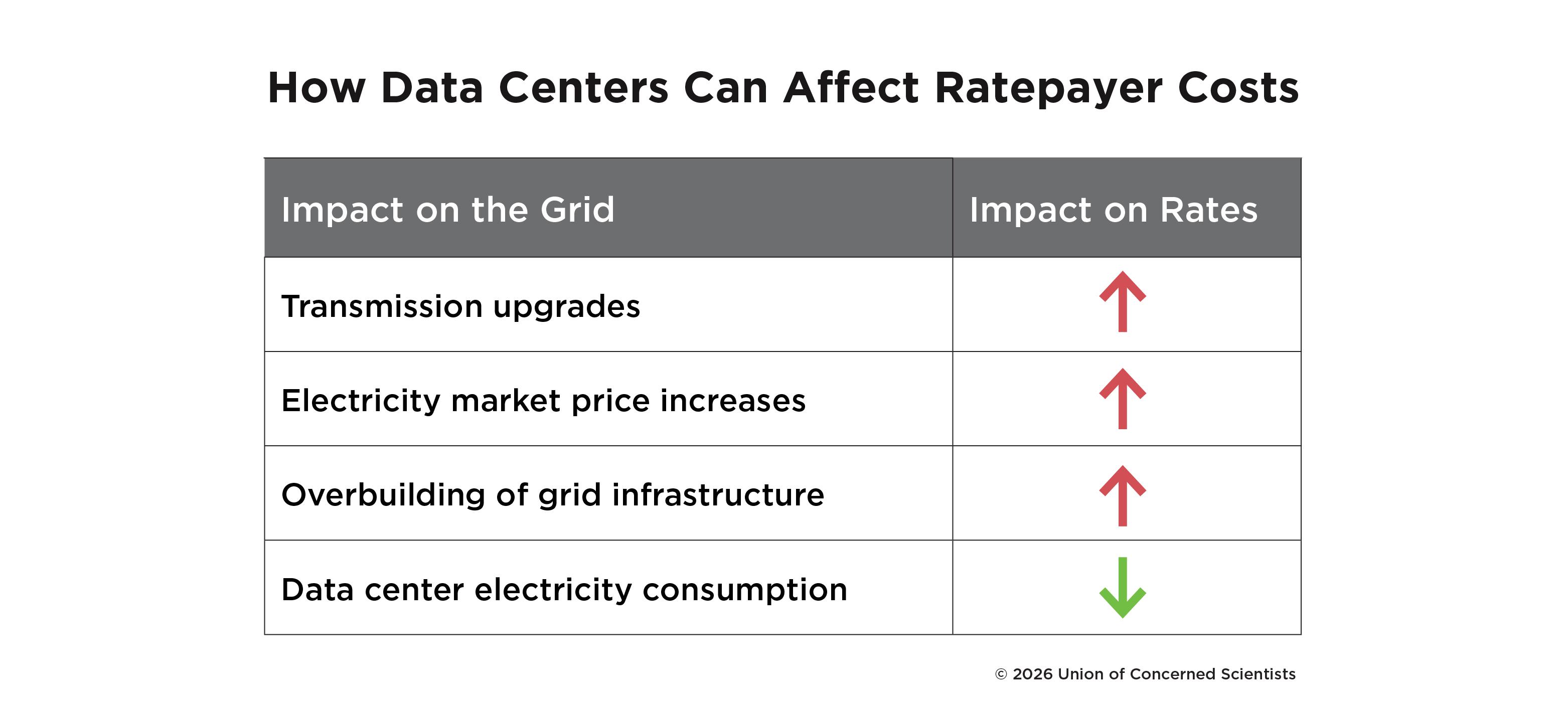
On the opposite side of the equation, data centers could drive down costs for ratepayers simply by using, and paying for, a lot of electricity (Table 1). Because electricity rates reflect not just the cost of electricity, but also fixed costs associated with maintaining the grid, spreading those fixed costs over a larger amount of electricity consumption can decrease electricity rates and, in turn, customer bills. However, because many data centers connect directly to the transmission system, they do not pay the costs of state policy programs and other grid costs that are recovered only from distribution system customers.
Given these possibilities, there is a distinct risk that data centers will increase ratepayer costs, because the state has too few rules protecting ratepayers (Box 1). California legislators and regulators should establish policies that ensure ratepayers do not end up paying for the build-out of transmission infrastructure triggered by data centers, for electricity market price increases caused by data centers, and for grid costs to connect data center demand that does not materialize.
PG&E's Rule 30 Provides Some Ratepayer Protections
Electric Rule 30, proposed by PG&E, is one of California's main policies protecting ratepayers from some---but not all---of the costs of data center load growth. The rule serves to streamline the process of connecting large electrical loads (including those from data centers) to the transmission system, and it also has some ratepayer protections regarding connection-related costs.
For example, the rule requires large load customers to pay up front for the actual costs of connecting to the transmission system. Then those charges are refunded over time as the data center continues to operate. Rule 30 will also likely guard against the risk of load that fails to materialize by including provisions such as minimum electricity demand charges, a minimum contract length, and early termination fees. However, those provisions have not yet been finalized.
Importantly, Rule 30 covers only the costs of connecting a large load to the transmission system that are clearly attributable to that large load. The rule does not currently cover broader transmission network upgrades triggered by large load connections, nor does it cover the energy market impacts of rapidly increasing demand. The rule also contains no requirements for data centers to bring their own clean generation or provide demand flexibility. Furthermore, Rule 30 applies only in PG&E's service territory, which covers less than half of California's population.
PG&E's Rule 30 is a step in the right direction, since it does provide some minimum protection for ratepayers in PG&E's service territory. However, additional statewide policies are needed to shield ratepayers and the electric grid from the broad range of risks that accompany data center load growth.
Recommendations
While data centers and the proliferation of AI pose a wide range of potential impacts on the economy, the environment, and society writ large, the following recommendations focus specifically on mitigating impacts on the state's electricity system and its ratepayers.
-
California legislators should establish statewide rules that ensure ratepayers will not shoulder the costs of data center growth. These rules should stipulate that data centers pay for all the costs caused by their connections to the grid, and these rules should also protect against the risk of data center electricity demand failing to materialize. In addition, California policymakers should require data centers to pay their fair share of the costs of state policy programs and other grid costs that are currently recovered only through distribution rates.
-
California legislators should require data centers to pay for new, clean electricity generation sufficient to meet the added data center demand. Data centers should also be incentivized to provide grid flexibility to help reduce peak demand. Such policies would help mitigate ratepayer impacts from increased electricity market prices and keep the state on track with its clean energy goals.
-
California legislators should create guardrails to minimize the use of fossil-fueled backup generation at data centers, for example, by forbidding their participation in demand response programs and incentivizing clean energy and energy storage as backup generation instead. Such guardrails would help protect nearby communities and local air quality.
-
California legislators should create new reporting requirements that provide more transparency into data center operations, including information on location, peak electricity demand, electricity usage, and backup generation usage. Such information would help policymakers understand the current grid and air pollution impacts of data centers, and it would help them mitigate those impacts.
-
California's grid operator should implement interconnection technical requirements and standards to ensure that data centers do not threaten grid reliability.
California is already home to many large data centers, and the state faces a significant amount of data center load growth. To protect ratepayers from the costs of connecting data centers, to keep the state's clean electricity transition on track, and to forestall potential grid reliability issues, California must establish new policies.
Authors
Mark Specht is a senior energy manager in the Western States Program at the Union of Concerned Scientists. Vivian Yang is a senior energy analyst in the program.
Acknowledgments
This project was made possible by the generous support of Heising-Simons Foundation and UCS members.
The authors would like to thank our external reviewers and our UCS colleagues Daniel Barad, Victoria Bortfeld, Michele Canales, Ranyee Chiang, Lana Cohen, Jeff Deyette, Samuel Dotson, Amanda Fencl, Julie McNamara, Jose Pablo Ortiz Partida, Lee Shaver, and Claudia Ward-de León for their many contributions. Special thanks to Heather Tuttle, Bryan Wadsworth, and Cynthia Williams for their expert handling of production and to Aurelio Acevedo for their mapping assistance.
The opinions expressed herein do not necessarily reflect those of the organizations that funded the work or the individuals who reviewed it. The Union of Concerned Scientists bears sole responsibility for the project’s content.
References
CAISO (California Independent System Operator). 2026a. Draft 2025--2026 ISO Transmission Plan. https://stakeholdercenter.caiso.com/InitiativeDocuments/Draft-2025-2026-Transmission-Plan.pdf
CAISO (California Independent System Operator). 2026b. Large Load Consideration Issue Paper. https://www.caiso.com/documents/issue-paper-large-load-consideration-jan-20-2026.pdf
CEC (California Energy Commission). 2026. "Power Plant Listing." Accessed April 24, 2026. https://www.energy.ca.gov/proceedings/power-plant-listing?field_project_type_value=SPPE&field_project_status_value=All&field_technology_value=Backup+Generating+System
Clemmer, Steve, Maria Fernanda Chavez, Samuel Dotson, James Gignac, Sandra Sattler, and Lee Shaver. 2026. Data Center Power Play: How Clean Energy Can Meet Rising Electricity Demand While Delivering Climate and Health Benefits. Cambridge, MA: Union of Concerned Scientists. https://doi.org/10.47923/2026.16051
Cooper, Mathew. 2025. 2025 IEPR: Preliminary Data Center Forecast. Sacramento, CA: California Energy Commission. https://efiling.energy.ca.gov/GetDocument.aspx?tn=267165&DocumentContentId=104331
Data Center Map. 2026. "California Data Centers." Accessed April 24, 2026. https://www.datacentermap.com/usa/california/
Jacobs, Mike. 2025. Connection Costs: Loophole Costs Customers Over $4 Billion to Connect Data Centers to Power Grid. Cambridge, MA: Union of Concerned Scientists. https://www.ucs.org/sites/default/files/2025-09/PJM%20Data%20Center%20Issue%20Brief%20-%20Sep%202025.pdf
Liu, Rui, Zhifeng Wu, and Shaolei Ren. 2025. An Assessment of California Data Centers' Environmental and Public Health Impacts. San Francisco, CA: Next 10; Riverside, CA: University of California, Riverside. https://www.next10.org/sites/default/files/2025-11/ai-environmental-public-health-costs.pdf
Monitoring Analytics. 2026. 2025 State of the Market Report for PJM, Volume 1: Introduction. https://www.monitoringanalytics.com/reports/PJM_State_of_the_Market/2025/2025-som-pjm-vol1.pdf
Quint, Ryan, Kyle Thomas, Jiecheng Zhao, Andrew Isaacs, and Casey Baker. 2025. Practical Guidance and Considerations for Large Load Interconnections. Elevate Energy Consulting and GridLab. https://gridlab.org/portfolio-item/practical-guidance-and-considerations-for-large-load-interconnections/