Table of contents
This is an online version of the report. The full report can be downloaded here.
The United States has a serious fertilizer overuse problem. Every year, producers apply millions of metric tons (MMTs) of synthetic fertilizers to agricultural farmland—for example, about 11.62 MMT of nitrogen fertilizer were used on US crops in 2023. Research shows that as much as 30 to 50 percent of applied nitrogen fertilizer is in excess of what crops can use, leading to enormous waste. The new Union of Concerned Scientists (UCS) report Less Fertilizer, Better Outcomes: USDA Conservation Programs Benefit Both Farmers and the Planet estimates that an excess of 3.5 to 5.8 MMT of synthetic nitrogen fertilizer was applied to US crops in 2023.
How does fertilizer overuse hurt farmers and the environment?
-
Synthetic fertilizers are expensive, costing farmers approximately $35.8 billion in 2023, according to the United States Department of Agriculture (USDA).
-
Fertilizer overapplication leading to wasted fertilizer is thus costly for farmers, increasingly so as fertilizer prices rise.
-
Excess nitrogen that is not absorbed by crops seeps into the surrounding environment, including bodies of water, and has harmful impacts on the environment and the health of people living in rural communities. Unabsorbed nitrogen fertilizer also transforms into heat-trapping gases, including nitrous oxide (N2O) and carbon dioxide (CO2), which travel into the atmosphere. N2O is 273 times more powerful than CO2 in capturing heat.
-
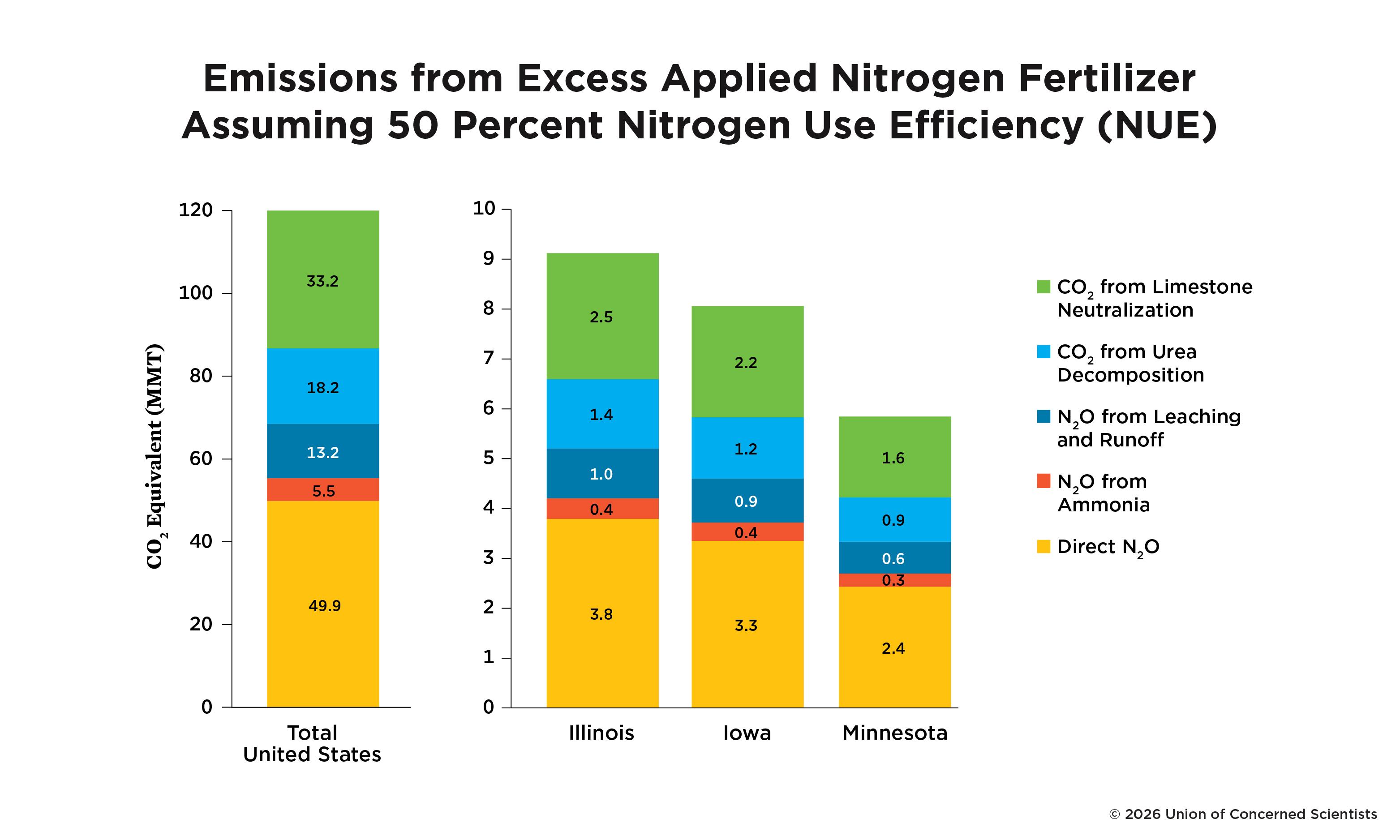
In 2023, nitrogen fertilizer overapplication was responsible for emitting an estimated 36 to 60 MMT of heat-trapping gas, equal to the emissions from up to 14 million gasoline-powered cars driven for a year (Figure 1).
USDA Programs Can Help, But They Need Strong Funding
To break the cycle of fertilizer dependency, producers need strong alternatives so they can move away from fertilizer practices that deplete soil health. Voluntary conservation programs administered by the USDA such as the Environmental Quality Incentives Program (EQIP) and Conservation Stewardship Program (CSP) provide financial and technical assistance to producers to implement conservation practices such as cover crops, buffer strips, restored wetlands, and managed grazing that help keep nutrients in place and build long-term soil health. These programs are backed by decades of scientific evidence and farmer experience, providing farmers confidence that implementing these practices will have measurable environmental health benefits.
Currently, demand for USDA conservation programs far exceeds the funding and resources available to support them. Socially disadvantaged producers, including farmers of color and those who run small- and medium-sized farms, have even more difficulty accessing conservation programs because these programs often require upfront investments, with producers being reimbursed a portion of the total cost they incur.
Policy Recommendations
-
UCS recommends that the next food and farm bill supports producers in implementing climate resilience initiatives by increasing funding for CSP, EQIP, and the Sustainable Agriculture Research Program, which awards grants to research and education projects that advance sustainable agriculture knowledge and skills.
-
UCS recommends that CSP and EQIP prioritize practices that improve soil health, reduce emissions of heat-trapping gases, and focus on climate resilience. Our analysis finds that these conservation programs not only have the potential to boost rural economies but also play a critical role in reducing heat-trapping emissions.
-
Making voluntary federal conservation programs accessible to more producers is an important step. However, it is also critical to transition away from the current monopolistic model of agriculture that values corporate profits over people and the environment. We need to diversify farming operations by integrating livestock and adopting an agroecological approach in our food and farm system. Congress and USDA should support producers in adopting farming practices that build soil health; replenish nutrients without harmful agrichemicals; clean water and air; protect soil biodiversity; and build resilience to extreme weather and other climate change impacts. These steps can help protect the environment and improve economic and environmental outcomes for producers.
Authors
Omanjana Goswami is an interdisciplinary scientist in the UCS Food and Environment Program. Precious Tshabalala is an economist in the program.