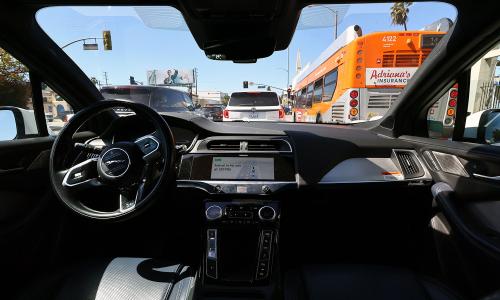
Transitioning to electric vehicles (EVs) will slash air pollution and heat-trapping emissions and avoid the daily consumption of millions of gallons of gasoline in the United States.
The nationwide transition is in its early stages and we have the opportunity to minimize the minerals needed for electrification and create a resilient, just, and sustainable EV supply chain.
UCS research quantifies the potential to minimize mineral demand for passenger cars and trucks in the United States through battery recycling, improved vehicle efficiency, right-sizing vehicle range for different driving needs, technological innovation, and increasing transportation options for people.
Key findings:
-
With smart policies, investments, and industry leadership, newly mined lithium needs can be reduced by nearly half (48 percent) from 2025 to 2050.
-
This reduction amounts to 1.5 million metric tons, equivalent to 180 million of today's typically sized EV batteries.
On this topic
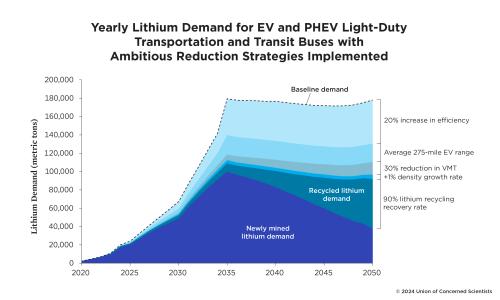
Yearly Lithium Demand for EV and Plug-In Hybrid Light-Duty Transportation and Transit with Reduction Strategies Implemented
Downloads
Citation
Dunn, Jessica, Don Anair, Kevin X. Shen, and Dave Reichmuth. Making the Most of Electric Vehicle Batteries: How Recycling, Innovation, and Efficiency Can Support a Sustainable Transportation Future. Cambridge, MA: Union of Concerned Scientists.
https://doi.org/10.47923/2024.15617
Related resources

All About Surface Transport Reauthorization

UCS vs Anti-Science Actions
Addressing Freight Pollution at the Source