Corporate consolidation—in which mergers and acquisitions of smaller
companies lead to fewer, larger companies—has been a trend for decades
in areas ranging from retail to technology. This consolidation gives
some corporations outsize power, a consequence President Biden addressed
in his 2021 executive order seeking to curb the “excessive concentration
of industry” (U.S. President 2021).
The food and agriculture sector is no exception to this troubling trend,
and the consequences can be far-reaching. For example, recent research
has shown that the nation's largest meat and poultry producer, Tyson
Foods (Statista 2022), has monopoly-like power that threatens the
health, safety, and well-being of chicken farmers, workers, and
communities in numerous ways (Boehm 2021a). Another recent study showed
how corporate consolidation in the US food system has increased food
prices and decreased food access (Howard and Hendrickson 2021).
In meat and poultry production, a key resource over which large
companies can exert control is the land used to grow crops for animal
feed. By affecting the supply chain both directly and indirectly
(through their influence on public policy, for example), large companies
can acquire a great deal of leverage over the way farmland is used and
managed. This control, in turn, can have significant consequences for
environmental and human health.
Congress, government agencies, and food companies can—and should—do more
to ensure that feed crops are grown sustainably and that competition in
the market is fair. Acting as the voice of the people, Congress makes
laws and provides oversight of government agencies that implement those
laws. Agencies such as the US Department of Agriculture (USDA) provide
support and technical assistance to farmers through various programs
that encourage sustainable farming practices. The USDA also enforces
laws intended to ensure fair competition in meat processing. The
Department of Justice and the Federal Trade Commission investigate
consolidation and enforce antitrust laws. Food companies like Tyson make
public sustainability commitments that are meant to guide their
businesses.
Below, the Union of Concerned Scientists (UCS) provides an overview of
the extent of feed crop production in the United States and its impacts
on natural resources and the environment. We then use Tyson as a case
study to explore the substantial role large companies play in this
aspect of the food system. Specifically, we estimate the amount of
cropland needed to feed all the animals Tyson processes, which
demonstrates the magnitude and consequences of Tyson’s potential impact
on land use, crop farmers, and the environment. Finally, we offer
recommendations for the company and policymakers to make Tyson’s meat
and poultry production more sustainable and resilient.
Feed Crop Production and Its Impacts
Animals raised for meat consume an enormous amount of feed each year,
and the crops predominantly used for this feed—corn and soybeans—take up
a proportionally large amount of land (Figure 1). Many livestock also
spend portions of their lives grazing (DeLonge 2016), but we do not
address the impact of that land use here.
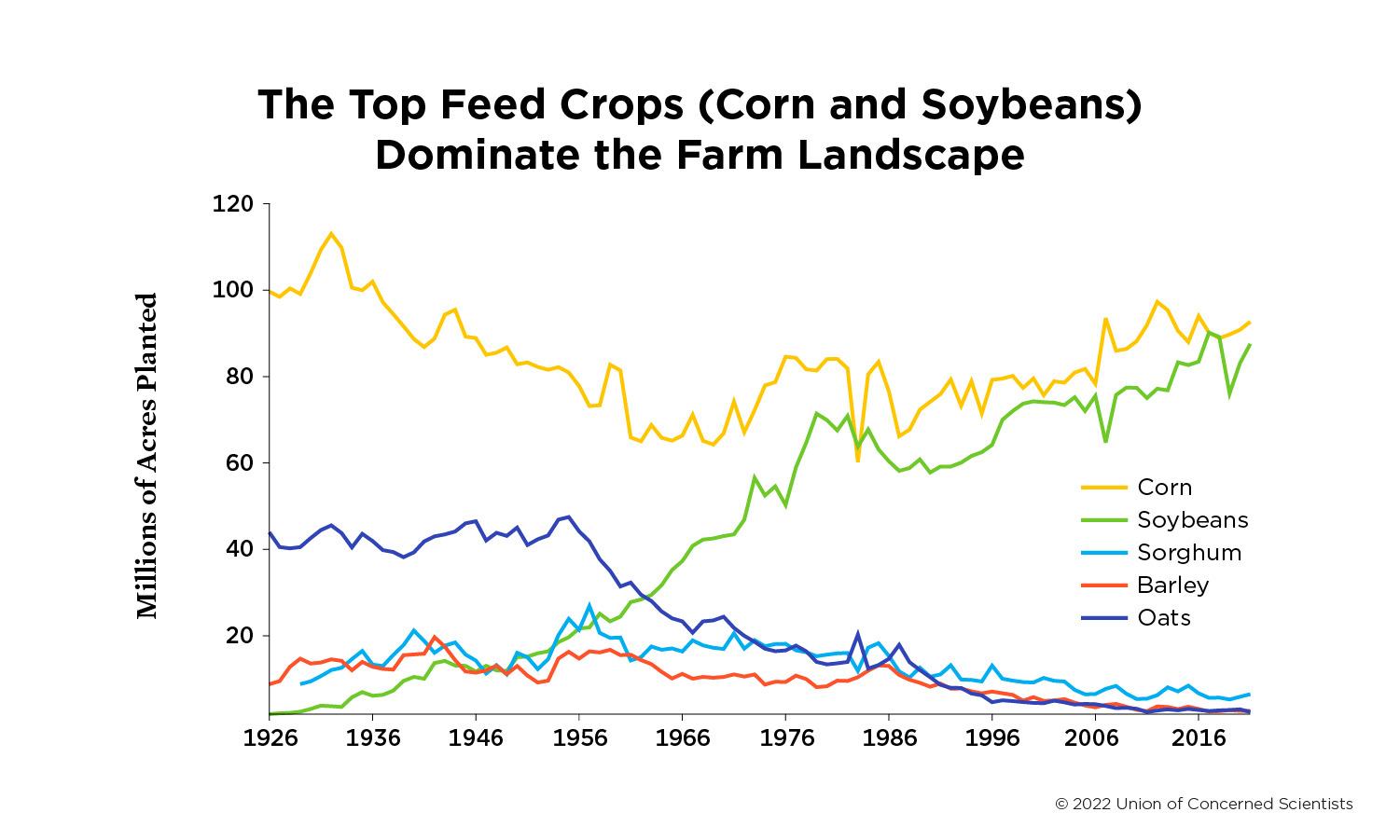
out of 310 million total acres of US cropland, are the country’s biggest
crops. Much of it goes to produce animal feed for companies like Tyson
Foods.
In 2020, US farmers planted corn and soybeans on 174 million acres (NASS
2020)—an area that is larger than Texas and accounts for more than half
(56 percent) of the country’s 310 million total cropland acres. While
some of these crops are used for other purposes, such as biofuels and
processed foods, a large portion is used for animal feed (ERS 2021a).1
Land use on this scale has significant impacts, as described below.
Further, because land used for feed crop production could otherwise be
used to grow foods eaten by people (Cassidy et al. 2013), feed crop
production ultimately affects everyone.
The dominant way that major feed crops, particularly corn and soybeans,
are grown in the United States negatively affects the health of our
soil, water, air, and climate (Stillerman and DeLonge 2019). Feed crop
production also has an impact on the health and well-being of farmers
and communities that live near, or downstream from, the land where these
crops are grown. For example:
-
Erosion. Healthy soil is a vital life-support system at the very
foundation of our farms and food. However, every year, in part due
to unsustainable farming practices, US croplands lose more than
twice as much soil to erosion as the Great Plains are estimated to
have lost annually during the peak of the Dust Bowl (DeLonge and
Stillerman 2020). -
Climate vulnerability. As climate change impacts worsen, farms
are increasingly threatened by extreme weather. At the same time,
soil loss and degradation, in part due to management practices,
leave farms and surrounding communities even more vulnerable to
droughts and floods that cause billions of dollars in damage each
year (Basche 2017). -
Polluted drinking water. Clean drinking water is vital to
healthy communities, but excessive fertilizer and manure application
on croplands—particularly without safeguards to prevent
runoff—results in widespread contamination. In the heart of corn
country, Iowa is projected to spend up to $333 million over the next
five years to remove nitrates from drinking water (Boehm 2021b).
These costs will likely be borne disproportionately by small rural
communities. -
Dead zones. When nitrogen and other nutrients build up too much
in water, they can cause excessive growth of algae, which in turn
depletes oxygen and harms aquatic ecosystems. For example, nitrogen
fertilizer runoff from the Midwest, particularly from corn fields,
has caused up to $2.4 billion per year in damages to fisheries and
marine habitats in the Gulf of Mexico every year since 1980 (Boehm
2020). Damages also occur in streams, rivers, and lakes between the
farms and the Gulf, such as in Lake Erie (USGS 2016).
These agricultural and environmental challenges are driven by a number
of factors, including the dominant farming practices and the public
policies that shape them through incentives and other forms of support
(UCS n.d.). Large agricultural companies also wield considerable power
(GRAIN and IATP 2018), both by influencing policy (Feed the Truth and
MapLight 2021) and controlling many links in the supply chain (Facing
South 2021).
Further, the environmental impacts of cropland management can be
amplified by farmland consolidation. For decades, the land used to grow
crops has been consolidated into larger and fewer farms, a trend that is
undermining rural economies and communities in the Midwest and across
the nation (Ferguson 2021). Companies and government policies have also
played roles in this trend. Thus, when examining the impacts of feed
crop production on communities and the environment, it is critical to
consider the role of companies such as Tyson that buy and produce these
crops in large quantities.
Estimating Tyson’s Feed Crop Footprint
Tyson Foods is one of the largest food companies in the world and a
major corporation by any measure, ranking 73rd among the Fortune 500 in
2021 (Fortune 2021a). By the company’s own estimation, it produces 20
percent of all chicken, beef, and pork in the United States (Tyson Foods
2021a). To support this massive operation, Tyson buys large amounts of
raw materials including live cattle, live swine, corn, soybean meal, and
other feed ingredients, much of which it sells to contracted producers.
In 2018, it produced around 10 million metric tons of feed in a total of
32 feed mills throughout North America—enough to make Tyson the
ninth-largest feed producer in the world (Reus 2020)—and it has opened
more mills since then. In 2021, feed production represented 59 percent of the
company’s domestic poultry production costs (Tyson Foods 2021b).
While a previous UCS analysis demonstrated Tyson’s monopoly-like control
over chicken farmers and workers (Boehm 2021a), the degree to which it
has influence over other parts of the supply chain has been unclear. To
better understand the company’s influence over cropland, we estimated
how many corn and soybean acres are needed to produce feed grains for
the animals Tyson processes.
We first estimated how many animals are needed for all of Tyson’s beef,
pork, and chicken products each year. Based on Tyson’s reported weekly
production capacities and utilization rates, we estimated that the
company processed approximately 6 million head of cattle, 22 million
hogs, and nearly 2 billion chickens in 2020.2
We then estimated the amount of corn and soybeans used to feed all these
animals, based on a previous study (Peters et al. 2014). For these
calculations, we relied on data and conversion factors from both Tyson
Foods and the USDA’s Economic Research Service (Table 1). Specifically,
we used Tyson’s values for animal live weight per head, and ERS values
for yields of animal carcass from live weight (ERS 1992) and yields of
boneless meat per animal carcass (ERS 2021b).
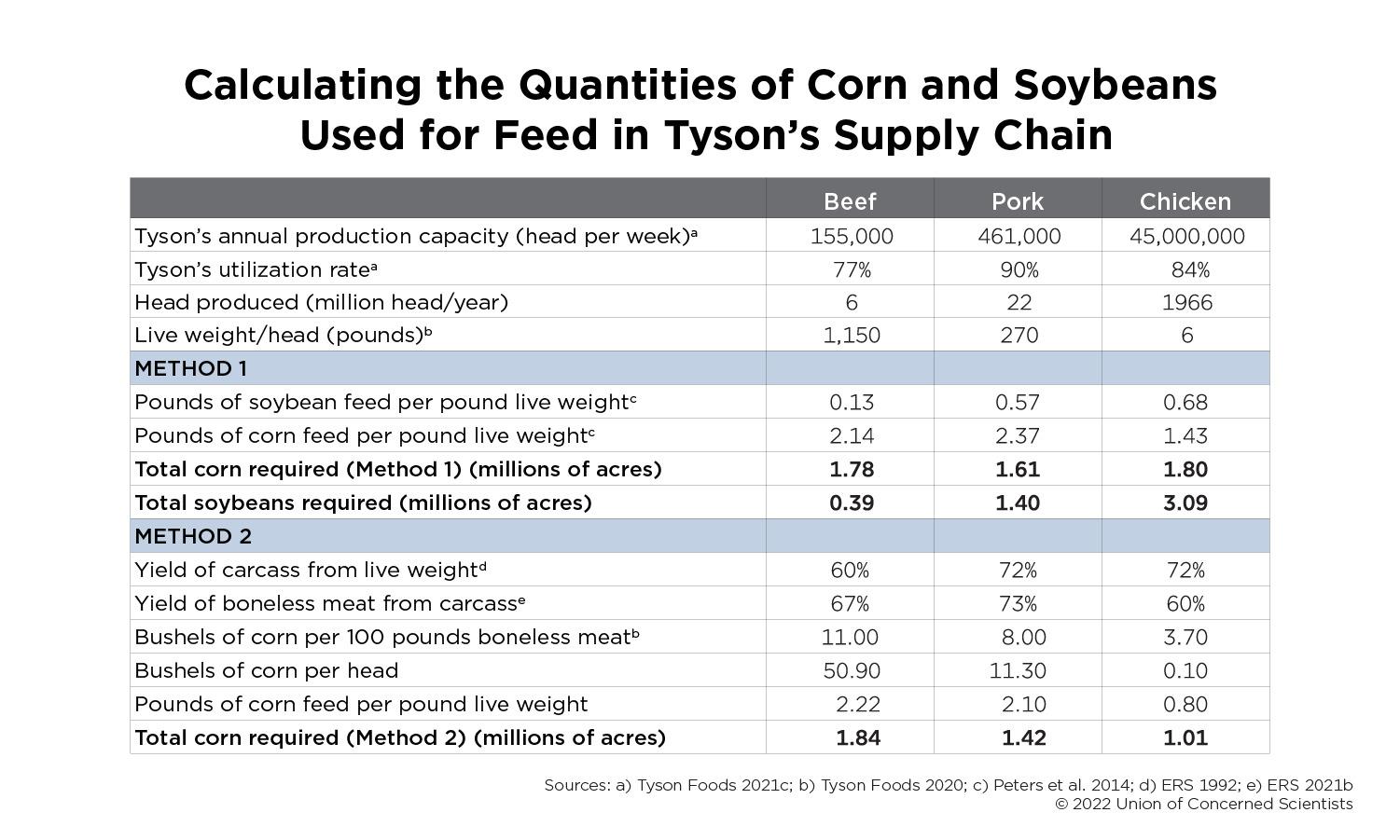
with the total head of chicken, beef cattle, and hogs produced by Tyson
in 2020. We estimated the corn and soybeans needed by using conversion
factors from Peters et al. 2014 (available in the Supplemental Material;
Feed Conversions Summary Tab). We converted pounds of soybean and corn
to bushels using USDA standard conversion rates (56 pounds per bushel
for corn, 60 pounds per bushel for soybeans) (ERS 1992). We converted
bushels of crops to acres of crops by multiplying the most recently
published yields (172 bushels of corn per acre, 50.2 bushels of soybean
per acre) (NASS 2021). We compared the estimated amount of corn needed
as calculated above with the amount of corn needed as calculated using a
second method based on Tyson’s estimates for the bushels of corn
required per 100 pounds of boneless meat. In this case, we converted
total head produced to pounds of boneless meat using conversion factors
from the USDA. After converting to bushels of corn using Tyson’s
estimates, we estimated acres of corn by multiplying by the most
recently published corn yields.
Note: Beef harvest weight is the average of the range of 900 to 1,400
pounds. We assume a broiler-roaster chicken of between five to six
pounds. These estimates are similar to the national commercial averages
of live weight per head reported by the USDA NASS in 2020: 1,373 pounds
for beef, 289 pounds for pork, and six pounds for chicken.
Finally, we estimated how many acres of land would be needed to grow
these feed crops. Based on our calculations, Tyson required between 4.3
million and 5.2 million acres of corn and 4.8 million acres of soybeans
in 2020 (Figure 2). That would make Tyson’s total feed crop footprint
between 9 million and 10 million acres—an area nearly twice the size of
New Jersey, and the equivalent of more than 5 percent of all US corn and
soybean acres planted in 2020.
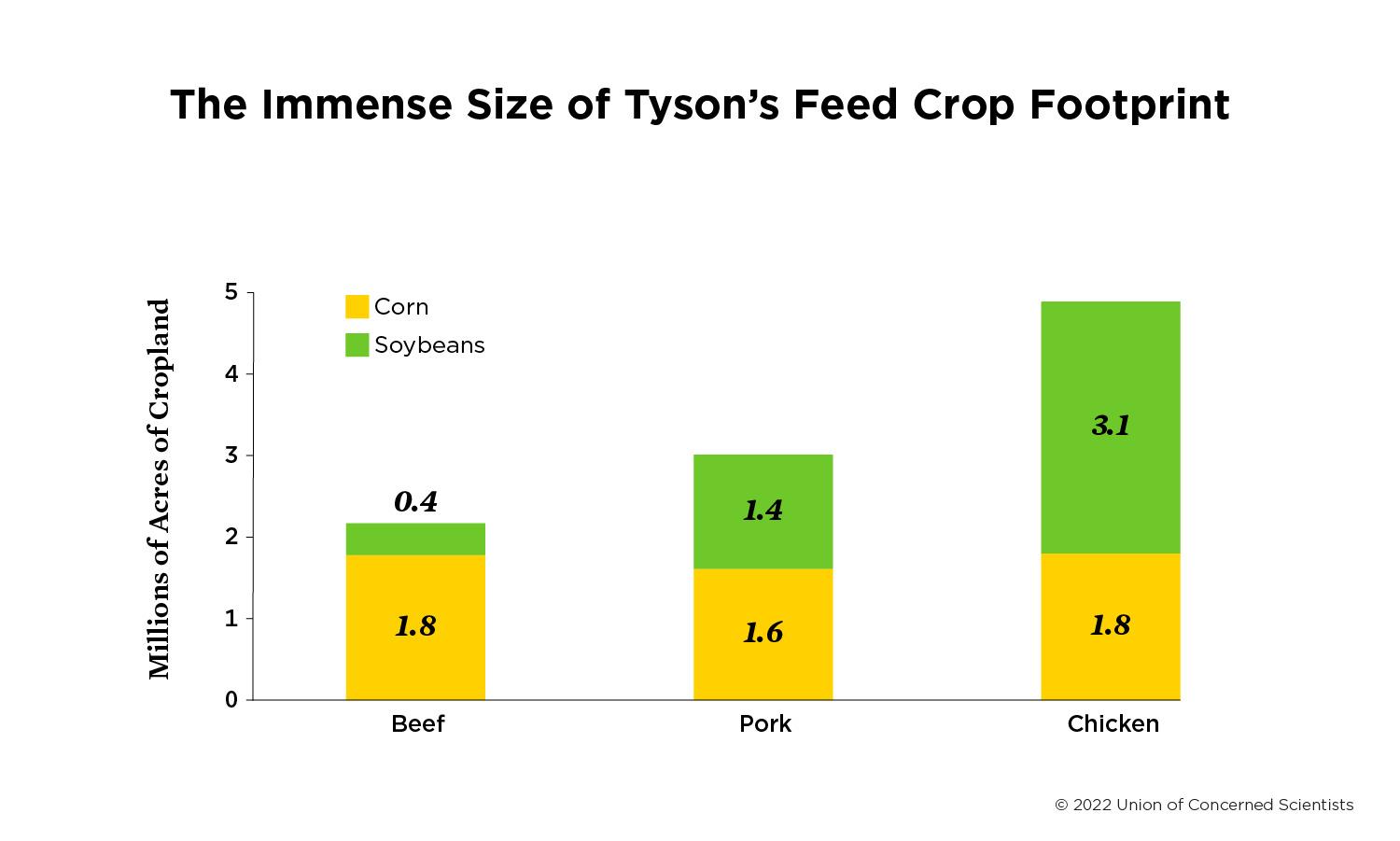
single company’s demand for animal feed requires between 9 million and
10 million acres of corn and soybeans—an area nearly twice the size of
New Jersey, and the equivalent of more than 5 percent of all US corn and
soybean acres planted in 2020.
Tyson’s Track Record on Land Management
With so much land involved in its feed supply chain, Tyson could help
move US agriculture in a positive direction if it used its influence to
set high standards for the way farmers manage that land, and if it
provided support for farmers in meeting these standards. Setting and
supporting high standards would make Tyson a leader in protecting the
land, soil, and water resources on which its business success depends.
But it would also be good for the broader environment, the climate, and
the communities near and downstream from where the feed is grown. The
scale of Tyson’s operations provides the company with an opportunity to
help solve the problems that current US agricultural practices cause.
Spurring improvements to feed crop production would begin to make real
the company’s stated purpose “to raise the world’s expectations for how
much good food can do” (Tyson Foods 2021d) and could help meet its
recently announced goal of achieving net-zero heat-trapping emissions by
2050 (Quad-City Times 2021).
Back in 2018, Tyson acknowledged the relevance of feed cropland for the
company’s sustainability footprint, establishing a goal to “support
improved environmental practices” on 2 million corn acres by the end of
2020 (Tyson Foods 2018). However, as of 2021, Tyson had only enrolled
408,000 acres into pilot programs (Tyson Foods 2021d) and pushed its
target date out to 2025, in part because of COVID-19 (Polansek 2021).
The cropland footprint we estimated is more than five times the size of
Tyson’s self-defined sustainability goal, and around 23 times the size
of its progress to date. With hundreds of millions of dollars in profits
in recent years (Fortune 2021b), Tyson has the resources to accelerate
its commitment to improving production practices.
The gap between Tyson’s goal of 2 million acres and the total acreage on
which its business relies points to the larger problem of the outsize
influence large food and agriculture companies have on farmers and
farmland in general. The scope of Tyson’s supply chain, including the
cropland underpinning its operations, and its dominance in meat and
poultry processing (Boehm 2021a) represent a challenge for shifting
farming practices in a way that is good for both the environment and for
all farmers, particularly small and midsize farmers and those farmers
who are Black, Indigenous, and other people of color. For example,
farmers operating on tight margins may have trouble affording the
up-front costs of more sustainable practices, whether or not buyers like
Tyson want them to adopt those practices—unless those buyers are willing
to support the changes. Tyson’s current approach to working with farmers
on improved environmental practices, in partnership with Environmental
Defense Fund and Famers Business Network (Tyson Foods 2019), is a
positive step, but given the extent of its cropland footprint, Tyson has
the potential to make changes far beyond its current commitments and
progress. Moreover, doing so would be in line with the company’s
professed commitment to sustainability and transformational change
(Tyson Foods 2021e).
Solutions
Tyson’s power over farming practices on millions of acres of cropland,
and its environmental implications, is part of a problem that requires
multiple solutions. For one, Tyson and other food companies must help
drive more resilient and sustainable land management in supply chains.
Further, no single company should wield the leverage over food and farms
that Tyson does. This power creates significant barriers to transforming
the agricultural sector, as large food companies may thwart needed
changes by simply choosing not to support them.
Toward this end, Congress and the USDA should expand programs that
encourage farmers to adopt improved farming practices, and advance
policies to limit consolidation and increase competition in agriculture.
Here are our specific recommendations:
Tyson Foods should use its buying power and resources to help farmers
employ practices that conserve and build healthy soil.
-
Tyson and other food companies should follow through with, and
strengthen their existing commitments to, improving supply chain
management in ways that help farmers adopt healthy-soil farming
practices. Companies can do this by setting higher sustainability
standards for the feed in their supply chains and offering farmers
they purchase from incentives to meet those standards. -
Tyson should also advocate for state and federal healthy-soil
policies that accelerate or incentivize the production of
sustainably grown grains.
Congress and the USDA should do more to drive farmers' transition to
healthy-soil practices.
-
Congress should pass the Agricultural Resilience Act (S. 1337/H.R.
2803), which would dramatically expand investments in farm
conservation and research. Such investments would enable more
farmers to participate in proven, high-demand conservation programs
(e.g., the Conservation Stewardship Program, the Environmental
Quality Incentives Program) while advancing understanding of the
most effective practices and systems (through the Sustainable
Agriculture, Research, and Education program and the Agriculture and
Food Research Initiative). -
Congress can also increase the availability of technical assistance
through university-based extension programs. -
The USDA should strengthen existing conservation and research
programs and develop new programs and initiatives that advance
resilient and sustainable agriculture. It is critical, as UCS has
advised the department (UCS 2021), that USDA programs and
initiatives emphasize a holistic, systems approach that addresses
persistent and interdependent challenges including climate
adaptation and mitigation, racial equity, and sustainability.
Federal regulators and Congress should act to increase competition in
the meat industry.
-
The Department of Justice and the Federal Trade Commission—which
have the legal authority to scrutinize and regulate antitrust
activity under the Sherman Antitrust Act of 1890 and the Clayton
Antitrust Act of 1914—should evaluate the degree of market power
that Tyson and other companies have acquired as a result of
concentration in meat and poultry supply chains. -
The USDA should act quickly on its stated intention (USDA 2021a) to
strengthen enforcement of the Packers and Stockyards Act of 1921,
which was meant to ensure fair competition and curb abuses in the
meatpacking industry. This should include swift yet sound
promulgation and implementation of rules that will protect farmers,
nearby communities, and poultry plant workers from the impacts of
the highly concentrated livestock industry. -
The USDA should continue investments, begun in response to the
COVID-19 pandemic, to expand small- and medium-scale poultry
processing, giving farmers new market opportunities and helping to
curb the negative effects of consolidation among meatpackers (USDA
2021b). At the same time, Congress must include long-term support
for small- and medium-sized processors in the 2023 farm bill,
through provisions such as the Strengthening Local Processing Act of
2021 (S. 370/H.R. 1258) and the Agricultural Resilience Act.
Marcia DeLonge is the research director and senior scientist in the
UCS Food & Environment Program. Karen Perry Stillerman is the senior
strategist and senior analyst in the program.
Acknowledgments
This report was made possible through the generous support of the
Grantham Foundation for the Protection of the Environment and UCS
members.
The authors would like to thank four anonymous reviewers for their
thoughtful comments and contributions. At UCS, the authors thank
Charlotte Kirk Baer, Rebecca Boehm, Cynthia DeRocco, Samantha Eley, Rich
Hayes, Mike Lavender, Kyle Ann Sebastian, and Bryan Wadsworth for their
help in developing and refining this report. Finally, we’d like to thank
Brian Middleton for his editing work.
The opinions expressed herein do not necessarily reflect those of the
organization that funded the work or of the individuals who reviewed it.
The Union of Concerned Scientists bears sole responsibility for the
contents of this analysis.
Endnotes
-
According to the USDA, 46 percent of corn used in the United States
goes to a category described as “feed and residual use,” which is
the amount used domestically that is neither "food, alcohol, and
industrial use” nor “seed use.” -
We estimated Tyson’s total head of chicken, beef, and pork produced
by multiplying its reported weekly production capacities for each by
the reported utilization rates of its production facilities. Both
values were reported for fiscal year 2020 on Tyson’s website
(https://ir.tyson.com/about-tyson/facts/default.aspx).
References
Basche, Andrea. 2017. Turning Soils into Sponges: How Farmers Can Fight
Floods and Droughts. Cambridge, MA: Union of Concerned Scientists.
https://www.ucsusa.org/resources/turning-soils-sponges
Boehm, Rebecca. 2020. Reviving the Dead Zone: Solutions to Benefit Both
Gulf Coast Fishers and Midwest Farmers. Cambridge, MA: Union of
Concerned Scientists.
https://www.ucsusa.org/resources/reviving-dead-zone
Boehm, Rebecca. 2021a. Tyson Spells Trouble for Arkansas: Its
Near-Monopoly on Chicken Threatens Farmers, Workers, and Communities.
Cambridge, MA: Union of Concerned Scientists.
https://www.ucsusa.org/resources/tyson-spells-trouble
Boehm, Rebecca. 2021b. Dirty Water, Degraded Soil: The Steep Costs of
Farm Pollution, and How Iowans Can Fix It Together. Cambridge, MA:
Union of Concerned Scientists.
https://www.ucsusa.org/resources/dirty-water-degraded-soil
Cassidy, Emily S., Paul C. West, James S. Gerber, and Jonathan A. Foley.
2013. “Redefining agricultural yields: from tonnes to people nourished
per hectare.” Environmental Research Letters 8(3): 4015.
https://iopscience.iop.org/article/10.1088/1748-9326/8/3/034015/meta
DeLonge, Marcia. 2016. While BBQ season sizzles, a case for healthy
farms and better beef. The Equation (blog), July 14.
https://blog.ucsusa.org/marcia-delonge/while-bbq-season-sizzles-a-case-for-healthy-farms-and-better-beef/
DeLonge, Marcia, and Karen P. Stillerman. 2020. Eroding the Future: How
Soil Loss Threatens Farming and Our Food Supply. Cambridge, MA: Union
of Concerned Scientists. https://www.ucsusa.org/resources/eroding-future
ERS (Economic Research Service). 1992. Weights, Measures, and
Conversion Factors for Agricultural Commodities and Their Products.
Washington, DC: U.S. Department of Agriculture.
https://www.ers.usda.gov/publications/pub-details/?pubid=41881
ERS (Economic Research Service). 2021a. Feedgrains sector at a glance.
https://www.ers.usda.gov/topics/crops/corn-and-other-feedgrains/feedgrains-sector-at-a-glance/
ERS (Economic Research Service). 2021b. Food availability (per capita)
data system.
https://www.ers.usda.gov/data-products/food-availability-per-capita-data-system/
Facing South. 2021. From the archives: Chicken empires.
https://www.facingsouth.org/2021/06/archives-chicken-empires
Feed the Truth and MapLight. 2021. Draining the Big Food Swamp.
Washington, DC: Feed the Truth.
https://feedthetruth.org/resources/the-political-clout-of-big-foods-trade-groups/
Ferguson, Rafter. 2021. Losing Ground: Farmland Consolidation and
Threats to New Farmers, Black Farmers, and the Future of Farming.
Cambridge, MA: Union of Concerned Scientists.
https://www.ucsusa.org/resources/losing-ground
Fortune. 2021a. Fortune 500.
https://fortune.com/fortune500/2021/search/
Fortune. 2021b. Fortune 500: Tyson Foods.
https://fortune.com/company/tyson-foods/fortune500/
GRAIN and IATP (Institute for Agriculture and Trade Policy). 2018.
Emissions Impossible: How Big Meat and Dairy Are Heating Up the
Planet.
https://grain.org/article/entries/5976-emissions-impossible-how-big-meat-and-dairy-are-heating-up-the-planet
Howard, Philip H., and Mary Hendrickson. 2021. Corporate concentration
in the US food system makes food more expensive and less accessible for
many Americans. The Conversation (blog), February 8.
https://theconversation.com/corporate-concentration-in-the-us-food-system-makes-food-more-expensive-and-less-accessible-for-many-americans-151193
NASS (National Agricultural Statistics Service). 2020. Quick stats.
Washington, DC: U.S. Department of Agriculture.
https://quickstats.nass.usda.gov/
NASS (National Agricultural Statistics Service). 2021. Crop Production
2020 Summary. Washington, DC: U.S. Department of Agriculture.
https://downloads.usda.library.cornell.edu/usda-esmis/files/k3569432s/w3764081j/5712n018r/cropan21.pdf
Peters, Christian J., Jamie A. Picardy, Amelia Darrouzet-Nardi, and
Timothy S. Griffin. 2014. “Feed conversions, ration compositions, and
land use efficiencies of major livestock products in U.S. agricultural
systems.” Agricultural Systems 130: 35-43.
https://www.sciencedirect.com/science/article/abs/pii/S0308521X14000778
Polansek, Tom. 2021. “Tyson Foods sets net-zero emissions goal, but
falls short on farming project.” Reuters, June 9.
https://www.reuters.com/business/sustainable-business/tyson-foods-sets-net-zero-emissions-goal-falls-short-farming-project-2021-06-09/
Quad-City Times. 2021. Biz Bytes: Tyson Foods Is Going Green.
https://qctimes.com/business/biz-bytes-tyson-foods-is-going-green/article_8ec5a8a3-7a58-511b-a993-f6691dd9ae1d.html
Reus, Ann. 2020. Tyson begins construction on Arkansas feed mill.
FeedStrategy (blog), May 11.
https://www.feedstrategy.com/animal-feed-manufacturers/tyson-begins-construction-on-arkansas-feed-mill/
Statista. 2022. Leading meat and poultry processing companies in the
United States in 2021, based on sales.
https://www.statista.com/statistics/264898/major-us-meat-and-poultry-companies-based-on-sales/
Stillerman, Karen P., and Marcia DeLonge. 2019. Safeguarding Soil: A
Smart Way to Protect Farmers, Taxpayers, and the Future of Our Food.
Cambridge, MA: Union of Concerned Scientists.
https://www.ucsusa.org/resources/safeguarding-soil
Tyson Foods. 2018. Sustaining Our World Together: 2018 Sustainability
Report.
https://www.tysonsustainability.com/downloads/Tyson_2018_Sustainability_Report.pdf
Tyson Foods. 2019. “Tyson Foods and EDF Launch Partnership to Accelerate
Sustainable Food Production.” Press release, January 15.
https://www.tysonfoods.com/news/news-releases/2019/1/tyson-foods-and-edf-launch-partnership-accelerate-sustainable-food
Tyson Foods. 2020. Investor Fact Book: Fiscal Year 2019.
https://s22.q4cdn.com/104708849/files/doc_factbook/2020/FactBookFY19_SinglePage-(Final).pdf
Tyson Foods. 2021a. Our story.
https://www.tysonfoods.com/who-we-are/our-story
Tyson Foods. 2021b. Form 10-K: Annual report pursuant to Section 13 or
15(d) of the Securities Exchange Act of 1934, for the fiscal year ended
October 2, 2021.
https://ir.tyson.com/sec-filings/sec-filings-details/default.aspx?FilingId=15352500
Tyson Foods. 2021c. Tyson Foods Facts.
https://ir.tyson.com/about-tyson/facts/default.aspx
Tyson Foods. 2021d. The Formula to Feed the Future: 2020 Progress
Report.
https://www.tysonsustainability.com/downloads/Tyson_2020_Sustainability_Report.pdf
Tyson Foods. 2021e. Sustainability.
https://www.tysonfoods.com/sustainability
UCS (Union of Concerned Scientists). n.d. Sustainable agriculture: Food
production in the United States is at a crossroads.
https://www.ucsusa.org/food/sustainable-agriculture
UCS (Union of Concerned Scientists). 2021. Comment from Union of
Concerned Scientists re: Request for comment on the USDA Climate-Smart
Agriculture and Forestry Partnership Program.
https://www.regulations.gov/comment/USDA-2021-0010-0219
USDA (U.S. Department of Agriculture). 2021a. “USDA to Begin Work to
Strengthen Enforcement of the Packers and Stockyards Act.” Press
release, June 11.
https://www.usda.gov/media/press-releases/2021/06/11/usda-begin-work-strengthen-enforcement-packers-and-stockyards-act
USDA (U.S. Department of Agriculture). 2021b. “USDA Announces $500
Million for Expanded Meat & Poultry Processing Capacity as Part of
Efforts to Increase Competition, Level the Playing Field for Family
Farmers and Ranchers, and Build a Better Food System.” Press release,
July 9.
https://www.usda.gov/media/press-releases/2021/07/09/usda-announces-500-million-expanded-meat-poultry-processing
USGS (U.S. Geological Service). 2016. Nutrients and sediment in the
Western Lake Erie Basin.
https://www.usgs.gov/centers/ohio-kentucky-indiana-water-science-center/science/nutrients-and-sediment-western-lake-erie
U.S. President. Executive Order. “Promoting Competition in the American
Economy, Executive Order 14036 of July 9, 2021.” Federal Register Vol.
86, no. 132 (July 14, 2021): 36987-36999.
https://www.federalregister.gov/documents/2021/07/14/2021-15069/promoting-competition-in-the-american-economy