Wildfires in the United States and Canadian boreal forests are projected to increase by as much as 169 and 150 percent, respectively, by 2050. They will have an outsized effect on climate change and the remaining carbon budget. Targeted fire management presents an opportunity to intervene and keep carbon out of the atmosphere.
Boreal forests store a huge amount of carbon—about two-thirds of what all forests store combined—so it’s imperative that fires, which release this carbon into the atmosphere, are minimized in these regions.
Fires that occur in US and Canadian boreal forests between now and 2050 could release up to about 3 percent of the remaining global carbon budget—equivalent to the annual emissions of 2.6 billion cars—unless greater investments are made to limit fires in these carbon-rich forests.
The study found that:
- We need to manage boreal forest fires differently—not only to protect people’s lives and property, but also to address climate change, which means investing more in boreal forest fire suppression.
- Fire management in boreal forests is a cost-effective way to reduce emissions, averaging about $12 to avoid 1 ton of carbon emissions.
- The United States should invest an average of $696 million a year over the next decade to keep Alaska’s forest fires and their carbon emissions in check.
On this topic
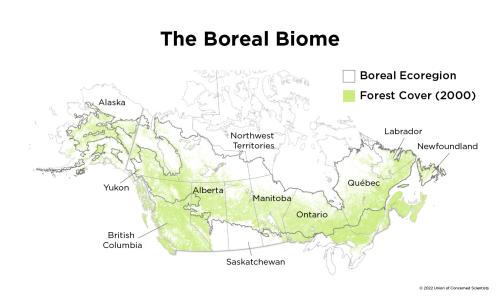
The Boreal Biome
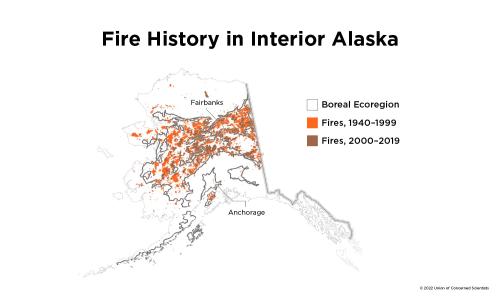
Fire History of Interior Alaska
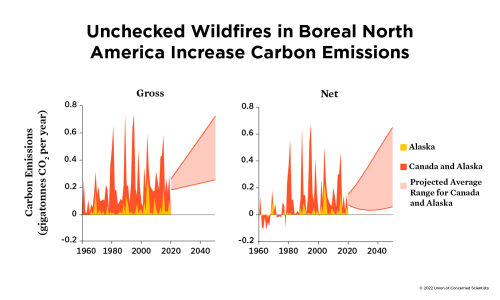
Unchecked Wildfires in Boreal North America

Wildfires in US, Canadian Boreal Forests Could Release Sizable Amount of Remaining Global Carbon Budget
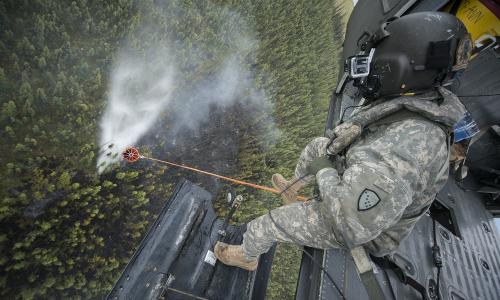
Escalating carbon emission from North American boreal forest wildfires and the climate mitigation potential of boreal fire management
Downloads
Citation
Phillips, C.A., Rogers, B.M., Elder, and Frumhoff, P.C. 2022. Limiting Carbon Emissions from Wildfires in North America’s Boreal Forests: Fire Management as a Carbon Mitigation Strategy. Cambridge, MA: Union of Concerned Scientists. https://ucsusa.org/resources/carbon-emissions-boreal-forest-wildfires
Phillips, C.A., Rogers, B.M., Elder, M., Cooperdock, S., Moubarak, M., Randerson, J.T., and Frumhoff, P.C. 2022. Escalating carbon emission from North American boreal forest wildfires and the climate mitigation potential of boreal fire management. Science Advances. DOI:10.1126/sciadv.abl7161
Related resources
Carbon Emissions Exacerbating the Western US Water Crisis
Wringing the West Dry
New England’s Offshore Wind Solution