States can reliably meet 100 percent of their electricity needs with renewable energy. They need comprehensive energy policies to ensure the transition is equitable.
The Union of Concerned Scientists joined with COPAL (Minnesota), GreenRoots (Massachusetts), and the Michigan Environmental Justice Coalition, to better understand the feasibility and implications of leadership states meeting 100 percent of their electricity needs with renewable energy by 2035.
We focused on 24 member states of the United States Climate Alliance, a bipartisan coalition of governors committed to the goals of the 2015 Paris Climate Agreement. We analyzed two main scenarios: business as usual versus 100 percent renewable electricity standards.
Our analysis shows that:
- Climate Alliance states can meet 100 percent of their electricity consumption with renewable energy by 2035. This holds true even with strong increases in demand due to the electrification of transportation and heating.
- A transition to renewables yields strong benefits in terms of health, climate, economies, and energy affordability.
- To ensure an equitable transition, states should broaden access to clean energy technologies and decision making to include environmental justice and fossil fuel-dependent communities—while directly phasing out coal and gas plants.
On this topic

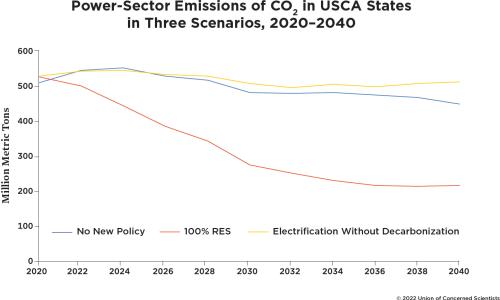
Power Sector Emission Projections

How Do We Get 100% Renewable Energy?
Downloads
Citation
García, Paula, Ashtin Massie, Bridget Saunders Vial, Edyta Sitko, James Gignac, John Rogers, John Walkey, Marco Hernández, Sandra Sattler, Sital Sathia, and Verónica López Gamboa. 2022. On the Road to 100 Percent Renewables: States Can Lead an Equitable Energy Transition. Cambridge, MA: Union of Concerned Scientists. DOI: 10.47923/2022.14533
Related resources

Carbon Emissions Exacerbating the Western US Water Crisis

Wringing the West Dry

Research Priorities for Climate Litigation